Ohio Farmers Union

Serving Family Farmers and Consumers Since 1934


United to Grow Family Agriculture Since 1934

  • About
    • The Farmers Union Triangle
    • Vision
    • OFU Leadership
  • Issues
    • 2020 Virtual Lobby Days
    • OFU Policy & NFU Policy
    • 2019 Lobby Day Registration
    • Get Involved!
    • NFU Climate Leaders
  • Education
    • 2019 OFU Essay Contest
    • Ohio Farmers Union Scholarships
    • Farm Safety
    • Renewable Energy Curriculum
  • Insurance
    • Hastings Mutual Insurance Co.
    • Health & Other Offerings
    • Ohio BWC Group Coverage
  • Join Us
    • Member Benefits
    • Insurance
  • Blog

Farm Meeting to Discuss Unvoted Property Tax Increases

April 6, 2017 By Ron Sylvester 1 Comment

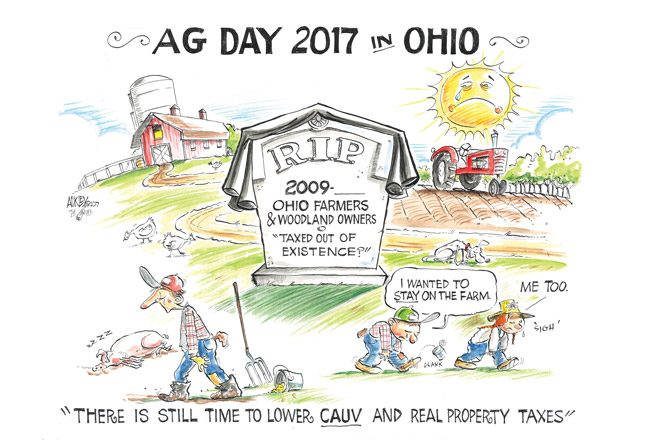
CAUV Increases of 300 to 600 Percent Need to be Addressed Say Ohio Farmers

COLUMBUS – Representatives from Ohio farm organizations and forest and woodland owners will be discussing the state’s broken farmland property tax system in Plain City on Tuesday, April 11.

Organized by Ted Finnarn, attorney for the Ohio Farmers Union, this public meeting is co-sponsored by OFU and the Ohio Farm Bureau along with Mayer Law, LTD of Waynesville, Rural King, Seed Consultants, Crop Production Services, EBY Trailers, Finnarn Ag Law, ASE Feed & Supply Store and the Ohio Farmers Union Family Farm Center.

Finnarn is a decades-long member of the CAUV Advisory Committee to the Ohio Dept. of Taxation. He has worked behind the scenes in Columbus since at least 2011 when CAUV (Current Agricultural Use Valuation) tri-annual re-valuations at the county level began to skyrocket 100 to 300 percent. Since then, many Ohio counties have been through two cycles of their CAUV values going up triple digits each cycle. In some cases, farmers’ property tax bills have grown 600 percent or more over the past six to eight years.

For the past three years, Finnarn, has worked across the state putting together public meetings on the issue. In Plain City, he is expected to give his presentation on CAUV and why we have it and why it worked from the 1970s to just recently. He will explain the modest changes in the state formula that need to occur and inform farmers and rural landowners what they need to do to help push legislation pending in Columbus that would fix CAUV.

Also presenting will be Leah Curtis of the Ohio Farm Bureau Federation and Paul Mechling representing Ohio forest and woodland owners. Finnarn said there will also be farmland conservation and woodland preservation experts available to farmers to answer questions regarding their land.

Dessert will be provided compliments of the sponsors.

This meeting is targeted at Champaign, Delaware, Franklin, Logan, Madison and Union Counties, but anyone is invited.

Details:

What: CAUV Public Meeting

When: Tuesday, April 11, 2 p.m.

Where: Der Dutchman, 445 S. Jefferson, Route 42, Plain City, Ohio 43064
-30-

Filed Under: Blog, Home-Feature

Minority, Women and Small Farmers’ Conference

March 15, 2017 By Ron Sylvester Leave a Comment

Central State University, an 1890 Land Grant institution, is holding a conference April 7-8 at their main campus for minorities, women and small farmers. According to their notice:

Through workshops, exhibits and presentations, you’ll gather techniques and resources to help improve your small farm operations. Network and strengthen existing partnerships with other small farm professionals, and take home new ideas to help ensure you not only survive, but thrive in today’s economy.

Learn all about it here!

Filed Under: Blog

CAUV – Ted Finnarn after OFU Testimony

March 14, 2017 By Ron Sylvester Leave a Comment

OFU members should know that Ted Finnarn has testified twice in the past few weeks on behalf of reforming CAUV to get rid of the wild swings upward in valuations (and taxes). Watch the video:

Filed Under: Blog, Home-Feature

Ohio Farmers Union Legislative Day is March 22

March 13, 2017 By Ron Sylvester Leave a Comment

Reminder – It’s Time to Sign Up

Stand up and be counted for CAUV reform and other public policy issues important to Ohio family farmers on March 22 at the Ohio Statehouse in Columbus.

Once again the Ohio Farmers Union will be spending the day visiting with Ohio’s state senators and state representatives in the home of the Ohio General Assembly. Topic number one in every meeting will be the continuing drastic increases in Current Agricultural Use Valuations around the state. It’s a state budget year, so we need all hands on deck to get the reforms OFU and other Ohio farm organizations are asking for. There’s no better way to show legislators how important any issue is to their constituents than to have voters show up in Columbus.

Fill out the form below to be included in one of the lobbying teams on March 22. Your team will include your own legislators in their visits via appointments made by OFU. A few days before the event, you’ll get an email with further details regarding the day’s schedule. We do know we’ll begin the day at 9 a.m. at the Statehouse.

Filed Under: Blog, Home-Feature

Maumee-Lake Erie Watershed Meeting for Farmers

February 8, 2017 By Ron Sylvester Leave a Comment

COLUMBUS – Ohio and national conservation and farming leaders will meet in March to try and answer the question: Can farmers in the Maumee Watershed successfully reach the needed 40 percent reduction in phosphorous runoff without federal intervention?

“The US and Canadian governments along with Ohio, Michigan, and Ontario have agreed on a 40% reduction target for phosphorus into Lake Erie,” said Ohio Farmers Union President Joe Logan.

“While most farmers in the Maumee and other Lake Erie watersheds are engaged in conservation and other best practices, we still have a target to meet,” Logan said.

“If we don’t accomplish this on our own, we’re going to end up with federal intervention – and that’s something we want to avoid.”

The meeting, “Farmers Together – The Solution!,” will be held Tuesday, March 21 at the Ostego High School Auditorium, 18505 Tontogany Creek Rd., Tontogany. The program starts at 7 p.m. It is being sponsored by OFU and St. Rose Peace and Justice.

[Read more…]

Filed Under: Blog, Home-Feature

OFU’s 2017 Policy Priorities

February 3, 2017 By Ron Sylvester Leave a Comment

Part of the delegates’ assembly at the 2017 OFU Annual Convention in Columbus.

Stemming the dramatic increases in taxes on farmland and compiling data on the density of livestock in Ohio’s watersheds lead the Ohio Farmers Union’s list of public policy priorities for the year.

CAUV, or Current Agricultural Use Valuation is the formula used to value farmland for tax purposes in Ohio. Since about 2011, that formula has not worked due to historically low Federal Reserve interest rates and market turmoil. While the Kasich Administration could change the formula administratively, OFU members are seeking the help of the Ohio General Assembly.

“Agricultural property tax increases are becoming an ‘existential threat ‘ to family farmers and rural land owners in Ohio,” OFU President Joe Logan said. “In recent years, our farmers have suffered increases in our CAUV of 300 to 600%, while Ag commodities have plummeted.”

“It’s just doesn’t make sense that yet another round of state income cuts will be paid for in part by farmers – after they’ve already contributed in the form of triple digit tax increases in previous budgets,” Logan said.

Logan said one issue that narrowly missed being passed by delegates was a proposed “$0 tax value” for Ohio’s woodlands.

“Woodlands owners are taking it on the chin in terms of taxes they pay versus the revenue those acres generate. Considering the environmental benefits that forests provide, we need to adjust tax rates to encourage more woodlands. The fact that we had a lengthy debate on our convention floor about zero tax values for woodlands should wake up policy makers in Columbus about the need to revamp CAUV,” Logan said.

Regarding water quality and harmful algal blooms in Lake Erie, Grand Lake St. Mary’s and other Ohio watersheds, Logan said OFU adopted a “special order of business” at its recent convention proposing some further action by the Ohio Dept. of Agriculture.

“Part of the solution to our ag nutrient problem is to avoid overloading livestock into watersheds – beyond the capacity of the cropland to utilize those nutrients.  As a first step in getting there, OFU proposes that the Ohio Dept. of Agriculture make an accurate assessment of all livestock operations within each watershed,” Logan said.
[Read more…]

Filed Under: Blog, Home-Feature

83rd Annual OFU Convention Kicks Off Friday

January 25, 2017 By Ron Sylvester Leave a Comment

Ohio Farmers Union to Debate CAUV, Water Quality

The Ohio Farmers Union will hold its 83rd Annual Convention beginning Friday, January 27, 2017.

Among public policy topics to be decided by the delegates are Ohio farmland tax issues and whether or not to establish carrying capacities for livestock in Ohio’s sensitive western Lake Erie watershed.

“We are delighted to announce the convening of the 83rd annual convention of the Ohio Farmers Union this coming weekend. Our convention will feature inspirational and educational presentations from key leaders in Ohio agriculture, thoughtful discussion on policy issues and great fellowship among members, delegates and guests. Please join us,” said OFU President Joe Logan.

Delegates will hear from a variety of speakers and decide whether to discuss and adopt number of policy priorities for 2017 including, setting livestock carrying capacities for the western basin of the Lake Erie watershed and making adjustments to the Current Agricultural Use Valuation (CAUV) of Ohio’s farmland.

CAUV will be an especially hot topic as many farmers around the state have experienced farmland property tax increases of 300 percent or more since 2008.

[Read more…]

Filed Under: Blog, Home-Feature

OFU Grateful for End of Trans-Pacific Partnership

January 24, 2017 By Ron Sylvester Leave a Comment

COLUMBUS – The Ohio Farmers Union today lauded President Donald J. Trump for taking executive action that will lead to the U.S. withdrawal from negotiations on the Trans Pacific Partnership.

“We appreciate that President Trump has prioritized the fulfillment of a major campaign promise by formally withdrawing from the Trans-Pacific Partnership,” said OFU President Joe Logan.

“Although farmers, like other businesses have adapted to a global matketplace, we believe that the TPP was deeply flawed. We are confident that a better agreement is possible, but getting one completed will be a major challenge,” Logan said.

TPP and prior trade agreements have failed to acheive a balance of imports and exports. They’ve also failed to have strong enforcement mechanisms regarding labor, the environment and currency.

“Like President Trump, OFU believes in fair trade and we thank him for following through on this campaign promise,” said OFU External Relations Director Ron Sylvester.

“We look forward to working with the Trump Administration on fixing other trade deals such as NAFTA,” Sylvester said.

“We also hope the Trump Administration will work to restore Country of Origin Labeling in the U.S. for beef, pork and poultry,” Sylvester said.

“U.S. farmers and packers are proud to label their meats with ‘U.S.A.’, and U.S. consumers want to know where their food comes from,” Sylvester said.

Filed Under: Blog

NFU: USDA Corn Ethanol Report Shows Environmental Benefits of RFS

January 15, 2017 By Ron Sylvester Leave a Comment

from National Farmers Union

Demonstrating the environmental benefits brought about by the Renewable Fuel Standard (RFS), a report released today by the U.S. Department of Agriculture (USDA) concludes that corn ethanol provides a considerable reduction in greenhouse gas (GHG) emissions compared to conventional gasoline.

 
The study found that in 2014, the use of corn ethanol provided a 43 percent reduction in lifecycle GHG emissions compared to use of conventional gasoline.

[Read more…]

Filed Under: Blog, Home-Feature

Trump’s Tweets Don’t Replace the Fourth Estate

January 3, 2017 By Ron Sylvester Leave a Comment

A recent blog posting by conservative firebrand and former Republican Speaker of the U.S. House, Newt Gingrich, touted the “Brilliance” of President-Elect Donald Trump’s controversial tweets, which advocated the expansion and strengthening of the U.S. nuclear arsenal.  Newt’s argument focused on his belief that long-standing U.S. policy – to work toward the reduction of global nuclear stockpiles – has allowed our relative nuclear advantage to stagnate. His message resonates with the long-standing Republican position in favor of expanding our military spending. Although I strongly disagree with expansion of our nuclear arsenal and the global implications that such an action would carry, I do agree with what Newt said next.

The former Speaker, who has been a keen observer of politics and the media for decades, went on to say that the real brilliance of his tweets was in the demonstration of his ability to “steer” the attention of media with his tweets. I don’t often find myself in agreement with Gingrich, but in this case, I must agree – at least in part.

Gingrich was celebrating the President–Elect’s success in bringing media attention to a favorite Republican issue – expanding the military. I happen to believe that his tweets may have had another purpose.

Gingrich failed to mention, perhaps intentionally, that Mr. Trump’s tweets had a second, and perhaps more strategically useful function. Those highly controversial tweets came at a moment in the Trump transition, when a very disturbing narrative was beginning to dominate media attention. During the preceding weeks, numerous stories about President-Elect Trump’s apparent coziness with Russian President Vladimir Putin had commanded loads of media attention.

Theories about Russian investments in Trump enterprises and scrutiny of the Russian government’s likely role in hacking into U.S. computer systems to influence our election in favor of Mr. Trump were being reinforced by the well-documented closeness of Trump’s nominee for U.S. Secretary of State, and CEO of Exxon Mobil, Rex Tillerson. The culmination of these issues was the disturbing concern that a new Trump administration might pursue policies, such as the removal of economic sanctions on Russia, which had been imposed following Russian incursions into Crimea and the Ukraine.  

If this diversion tactic was indeed the strategic purpose, it was indeed brilliant -and disturbingly effective.

It was truly brilliant in its effectiveness in completely erasing a very bad narrative and replacing it with an alternative that counteracts the former. So, rather than worrying that a President Trump and his appointees might be doing the bidding of a historic adversary, the media is now fixated on the concerns that a President Trump might begin a very contentious nuclear arms race with the Russians. Despite their obvious political utility, Trump’s tweets can be viewed as extremely disturbing for their effectiveness in diverting media attention away from an issue of high importance to national security.

 Historically the media has served an enormously important function in bringing transparency to our democracy.  Since the Watergate era, however, the “mainstream media” has been used relentlessly as a “punching bag”, alleging a liberal bias, even despite the requirement by the traditional media outlets for multiple source verification. This incident both illustrates the alarming effectiveness of the conservative strategy of relentless criticism, and in some ways, it highlights the justification for well-deserved criticism of many elements of our current American media environment.

Prior to the internet and cable news era, most folks got their news from a small handful of professional media outlets. Those professional news programs held themselves to very high standards for honesty and accuracy. As a result, their news anchors were historically regarded as among the most trusted folks in America.

In recent years, the traditional television news media environment has proliferated into a broad array of 24 hour cable news outlets and an even broader array of internet websites and news blogs, many of which have their own particular political agendas. The consumption of news has become a buffet affair, with dozens or hundreds of internet and broadcast sources available at any given time. Sadly, most of the broadcast news outlets have become more like corporate entertainment outlets, offering a continuous loop of generic news clips followed by a narrow band of commentary reflecting their station’s political orientation. Internet news sources are as varied as the mind can imagine, including a range of “mainstream” websites and a seemingly unlimited range of issue or philosophy-oriented websites that range from anarchists to white Nationalists to conspiracy theorists.

Our nation has an urgent need for credible, reliable news outlets that remain above the clutter of partisan demagoguery. We could regain this status if the handful of mature national broadcast news corporations were to dedicate a serious proportion of their earnings to news programing that would not be required to be profit centers. That is not likely. Barring that, we could rely on publicly-funded  broadcast outlets, like the Guardian, Free Speech TV, BBC or even hybrids like PBS.

Filed Under: Blog

« Previous Page
Next Page »
  • Email
  • Facebook
  • RSS
  • YouTube

Latest News from the Ohio & National Farmers Union

OFU Rallies for Rural Schools

Fair School Funding Plan Integral for Rural Public Schools COLUMBUS – The League of Women Voters of Ohio and Ohio Farmers Union held a Statehouse … Read More

Public Schools Build Connections in Rural Communities. Vouchers Tear Them Down.

by Melissa Cropper, president, Ohio Federation of Teachers This op-ed was orignally published on Barn Raiser: Rural communities depend on … Read More

National Farmers Union Week of Action for Strong Farm Bill

National Farmers Union (NFU) today concluded the Week of Action that gathered more than 100 farmers from across the country to the halls of Congress … Read More

How Do Tariffs Affect Family Farms?

A Talk in Kent, Ohio with Ohio Farmers Union and Others Have you noticed the price of eggs? Who hasn’t! How do government actions and tariffs … Read More

Check Out the Entire Blog

NATIONAL FARMERS UNION

Click to Take Action


Contact

Ohio Farmers Union
P.O. Box 363
1011 N. Defiance Street
Ottawa, Ohio 45875
Phone: (419) 523-5300
Toll Free: (800) 321-3671

Copyright Ohio Farmers Union© 2025 | Site by: RCS Communications


Loading Comments...