by Joe Logan
President, Ohio Farmers Union
Northeastern Ohio winters are notoriously gloomy. In a normal year, only 32% of the total available sunlight manages to pierce the cloud layers that roll south from Lake Erie during the late fall and early winter months. It’s rare to see a sunrise this time of the year, but December 20, 2016 has been a pleasant exception to that rule. I’m always surprised at how far south it has migrated and how impotent its rays have become. That is especially true today, as it has reached its most southerly path. Despite this season’s customary gloom, I have always found encouragement in the fact that following the winter solstice, days will begin to progressively lengthen, in their inexorable march toward spring.
Each season carries a similarity to that of the prior year, as well as its own individual signature. December of 2016 carries on the tradition of marking a rather dramatic departure from the warmer autumn temperatures, and true to the variety that is inherent in nature, this year shows a distinctly chilly identity of its own.
Our summer and autumn have been quite warm this year. In fact most months in 2016 have established records for the highest average global temperatures ever recorded. The undeniable accumulation of data clearly demonstrate to anyone with even a slightly open mind, that climate change is happening and that humankind will need to be addressing the causes and adapting our behavior. The sooner we acknowledge that and set ourselves to the task, the better it will be for all of us.
Adaptation will not be a linear process, as natural systems are notoriously dynamic. We cannot simply crank up our air conditioners to accommodate to a warming planet. Climate scientists have long been warning us to be prepared for a wide variety of weather conditions, including an extreme warmth in summer, extreme cold in winter seasons and extreme weather events, including intense storms in all seasons.
Even here in Northern Ohio, a white Christmas is a bit of a statistical rarity. This year, however, it is pretty well locked in, as we are in the midst of what weather forecasters have dubbed a “polar vortex”, -a protracted period of extremely cold temperatures characterized by an abnormal intrusion of frigid arctic air plunging into temperate latitudes.
The jet stream is a well-known fixture in climate dynamics. It is a reasonably consistent, stream of air that circles the globe at velocities of around 250 MPH, keeping polar air corralled in the arctic regions and acting as a barrier between cold arctic air and warmer temperate air. The polar vortex represents a distortion or weakening of the normally predictable jet stream, allowing massive volumes of polar air to escape containment by the jet stream and invade temperate regions.
Polar vortices are not only uncomfortable, they are dangerous, with extreme cold temperatures, ice and snow storms threatening livestock and causing significant property damage. Historically, such phenomena have been rare, but in recent years, they seem to have become more of a regular occurrence.
 OFU CAUV expert and attorney Ted Finnarn said, “Many farmland owners have suffered property tax increases between 300% and 800% during the past few years.”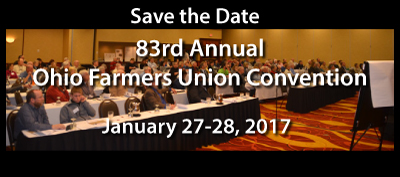
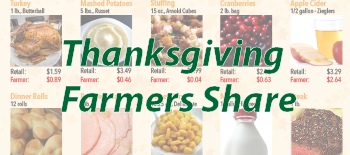 Consumers’ holiday food costs have declined, but farmers still receive less than 20 percent of the food dollar, according to the annual Thanksgiving edition of the National Farmers Union (NFU) Farmer’s Share publication. The popular Thanksgiving Farmer’s Share compares the retail food price of traditional holiday dinner items to the amount the farmer receives for each item.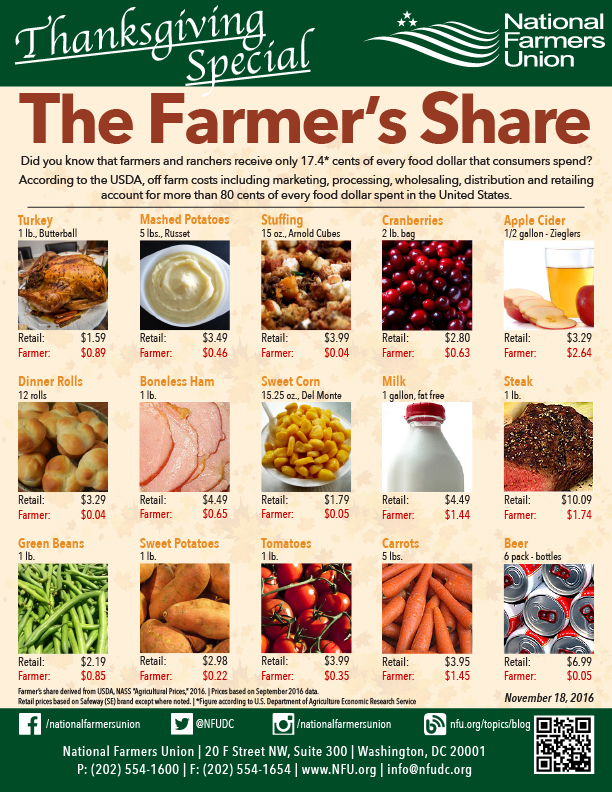

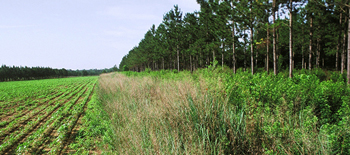 Recognizing the importance of fostering conservation and sustainability practices, National Farmers Union (NFU) is pleased by yesterday’s introduction of bipartisan legislation that would ease burdensome requirements for landowners participating in voluntary U.S. Department of Agriculture (USDA) conservation programs.