Ohio Farmers Union

Serving Family Farmers and Consumers Since 1934


United to Grow Family Agriculture Since 1934

  • About
    • The Farmers Union Triangle
    • Vision
    • OFU Leadership
  • Issues
    • 2020 Virtual Lobby Days
    • OFU Policy & NFU Policy
    • 2019 Lobby Day Registration
    • Get Involved!
    • NFU Climate Leaders
  • Education
    • 2019 OFU Essay Contest
    • Ohio Farmers Union Scholarships
    • Farm Safety
    • Renewable Energy Curriculum
  • Insurance
    • Hastings Mutual Insurance Co.
    • Health & Other Offerings
    • Ohio BWC Group Coverage
  • Join Us
    • Member Benefits
    • Insurance
  • Blog

NFU’s Johnson blasts Congress on idea to extend 2008 Farm Bill

July 30, 2012 By Ron Sylvester Leave a Comment

Wasn’t there a time in America when the good people who represent us in Congress could lay aside political differences and do serious public policy when the nation faced emergency? Wouldn’t you say that the worst U.S. drought since the 1950s might be just such an emergency?

Leaders in the U.S. House of Representatives think differently. The latest proposal is to lay aside the Senate Farm Bill (passed) and the House Farm Bill (through committee) and just extend the current law. Here’s what National Farmers Union President Roger Johnson said today on the subject:
[Read more…]

Filed Under: Blog Tagged With: 2008 Farm Bill, 2012 Farm Bill, National Farmers Union, Roger Johnson

UPDATE: U.S./Ohio Drought Online Resources

July 30, 2012 By Ron Sylvester Leave a Comment

According to the USDA’s Economic Research Service, 62 percent of U.S. farms are now affected by drought conditions which stretch across the country from Rhode Island to California in the continental U.S. and includes most of Hawaii.

In Ohio there are currently four counties in the state’s northwest corner with USDA drought designation: Williams, Defiance, Paulding and Van Wert. Ohio’s four counties are listed as “contiguous designations” as they are adjacent to four counties in Indiana which are counties with “primary” designations.

The ERS says on its website that it’s impossible to say exactly how much food prices will be impacted by the drought, but does say based on past experience and how inputs move through our system of food that consumers can expect the following:

  • Beef, pork, poultry and dairy prices will likely begin to be impacted in two months. Packaged and processed foods with corn and soybean inputs could take 10 to 12 months for full price impacts.
  • When herds are culled during droughts, there could be some short-term price reductions in certain meat products due to increased short-term supply.
  • Historically, if the farm price of corn increases 50 percent, then retail food prices as measured by the Consumer Price Index (CPI) increases by 0.5 to 1 percent. More generally, as an overall commodity price index increases, about 14 to 15 percent of that increase is passed on to retail prices for products that use that commodity as an ingredient.
  • Based on 2010 data 2/3 of U.S. crops and 2/3 of U.S. livestock are in drought areas.

A few online resources

  1. The USDA’s Drought Page – contains the latest news releases and other information from USDA focusing on agency actions and farmer assistance due to the drought.
  2. The U.S. Drought Monitor – is a multi-agency effort focused on recording the drought levels and severity across the U.S. The map on this page is related the severity of drought, not whether a particular county has been designated by USDA Secretary Tom Vilsack or any other official as in an emergency or other special status.
  3. The National Drought Mitigation Center – focuses on drought impacts and the science of droughts.
  4. The Office of the State Climatologist for Ohio – contains many links to climate and weather-related information regarding Ohio.
  5. Ohio Dept. of Agriculture Drought Information Page – contains links to information including SBA loan information for those affected by the drought.
  6. OSU Extension – Managing the Drought of 2012 – tons of information and links covering farm and home topics.
  7. Midwest Climate Watch – site contains lots of data and graphics regarding the drought, focuses only on the midwest.

Filed Under: Blog

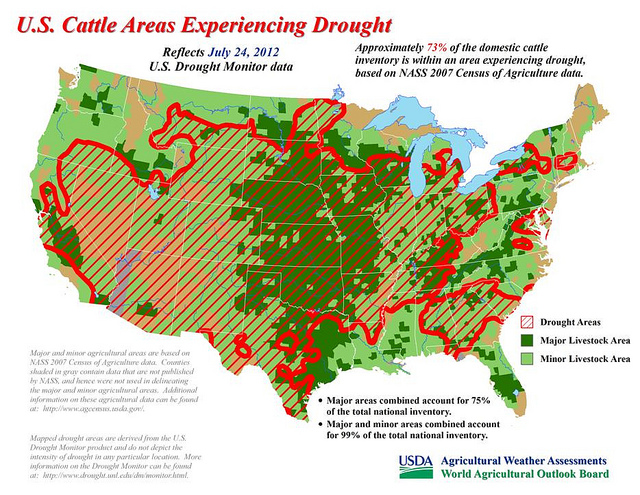
73% of U.S. cattle in regions experiencing drought conditions

July 30, 2012 By Ron Sylvester Leave a Comment

Filed Under: Blog Tagged With: Cattle, Drought

DROUGHT: Corn conditions in Ohio worse than nation as whole

July 30, 2012 By Ron Sylvester Leave a Comment

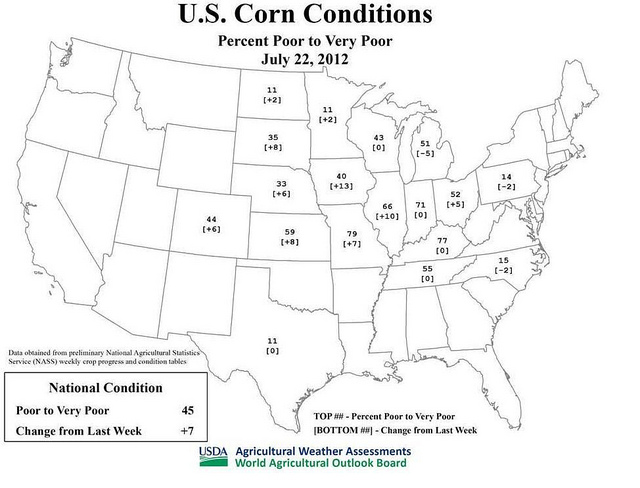
More than half of Ohio’s corn crop is rated poor to very poor for July – a number up 5 percent since last month. Nationwide, 45 percent of the corn crop is rated poor to very poor.

Filed Under: Blog Tagged With: Corn, Drought, Ohio

DROUGHT: Ohio soybean conditions match national average for ‘poor’ to ‘very poor’

July 30, 2012 By Ron Sylvester Leave a Comment

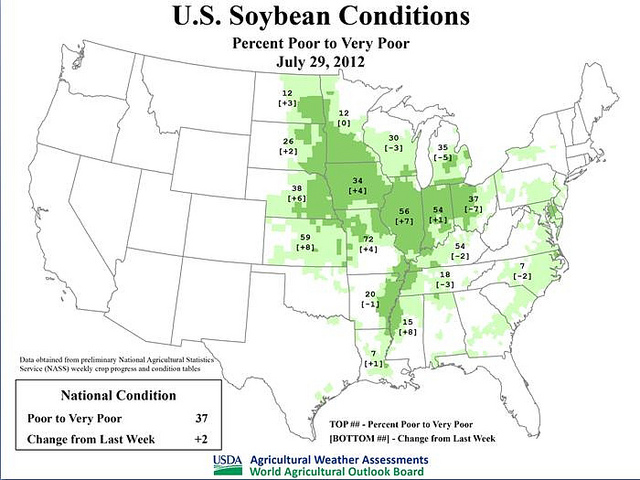
Not since the drought which hit the U.S. in 1988 has 37% of the nation’s soybean crop been rated at poor or very poor. Thirty-seven percent was the highest number for poor to very poor reached in July of 1988.

Filed Under: Blog Tagged With: Drought, Ohio, Soybeans

USDA: Macro picture could be worse …

July 30, 2012 By Ron Sylvester Leave a Comment

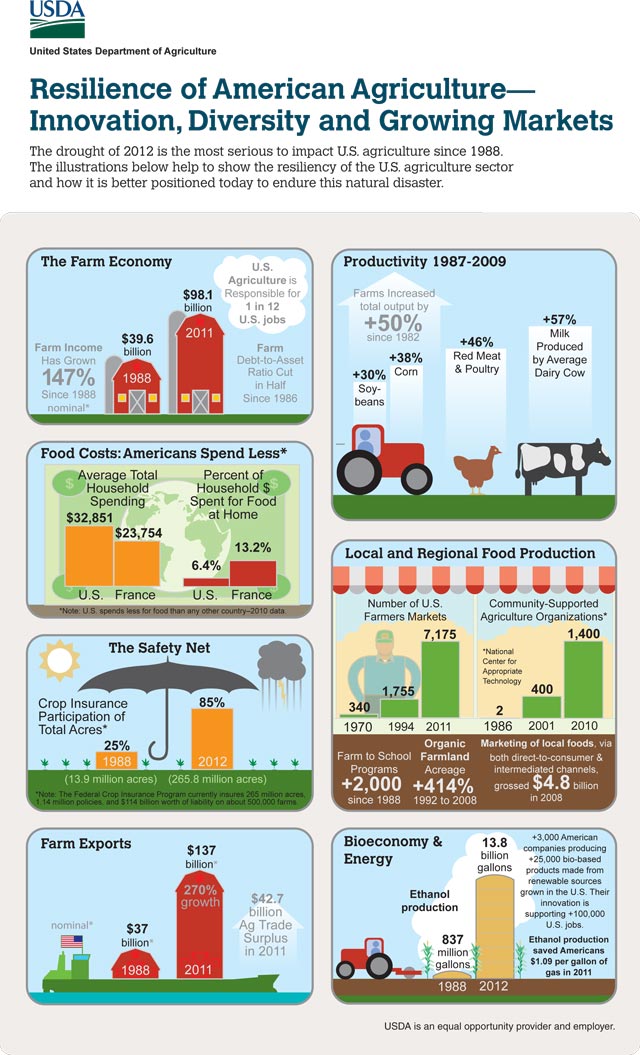
Although it’s cold comfort if your corn is dying or you’ve been feeding hay to grass fed beef for 6 weeks this summer, the USDA released this infographic to basically say: “It could be worse.”

The department says this is the greatest environmental challenge to U.S. agriculture since 1988, but that advances over the ensuing years have made the industry more resilient. Perhaps this message is aimed more at consumers. Leave a comment and tell us your thoughts in the comments. (Click the graphic for a full-size, pdf version.)


Filed Under: Blog Tagged With: Drought, Infographic, USDA

Wise, Zumbrink speak out on Farm Bill & drought

July 30, 2012 By Ron Sylvester Leave a Comment

Ohio Farmers Union President Roger Wise and longtime member James Zumbrink were quoted in the Columbus Dispatch today regarding the drought and Congress’ inattention to the Farm Bill.

This year’s drought, affecting a huge swath of the United States is severely disrupting agriculture from corn to livestock grazing. Here’s a bit of the Dispatch coverage – click the link at the end to read the whole story at their website:

[Read more…]

Filed Under: Blog Tagged With: 2012 Farm Bill, Columbus Dispatch, Drought, James Zumbrink, Roger Wise

Emergency haying and grazing for CRP participants in Ohio

July 28, 2012 By Ron Sylvester Leave a Comment

COLUMBUS –  Ohio Farm Service Agency (FSA) State Executive Director Steve Maurer announced additional drought relief for Ohio’s livestock producers today. Secretary of Agriculture Tom Vilsack authorized the release of emergency haying and grazing lands for all Ohio counties for certain practices and acres enrolled in the Conservation Reserve Program (CRP).

USDA will allow acres under CRP to be used for haying or grazing under emergency conditions. This will allow lands that are not yet classified as “under severe drought” but that are “abnormally dry” to be used for haying and grazing. This will increase available forage for livestock.

Under emergency haying at least fifty percent of each field or contiguous fields must be left unhayed for wildlife. Under emergency grazing at least twenty-five percent of each field or contiguous CRP fields must be left ungrazed for wildlife, or graze not more than seventy-five percent of the stocking rate as determined by NRCS.

Under emergency haying and grazing CRP participants will be assessed a payment reduction based on the number of acres actually hayed or grazed times the CRP annual rental payment times ten percent.

Participants may sell hay harvested under emergency provisions. CRP participants who do not own or lease livestock may rent or lease the haying or grazing privilege to an eligible livestock producer.

CRP is a voluntary program that provides producers annual rental payments on their land in exchange for planting resource conserving crops on cropland to help prevent erosion, provide wildlife habitat and improve the environment.

Producers must notify their local FSA office and file a request and receive approval before starting this emergency haying and grazing activity.

Filed Under: Blog Tagged With: Drought, Grazing, Haying, Ohio

U.S. Drought Facts and Resources

July 23, 2012 By Ron Sylvester Leave a Comment

According to the USDA’s Economic Research Service, 62 percent of U.S. farms are now affected by drought conditions which stretch across the country from Rhode Island to California in the continental U.S. and includes most of Hawaii.

In Ohio there are currently four counties in the state’s northwest corner with USDA drought designation: Williams, Defiance, Paulding and Van Wert. Ohio’s four counties are listed as “contiguous designations” as they are adjacent to four counties in Indiana which are counties with “primary” designations.

The ERS says on its website that it’s impossible to say exactly how much food prices will be impacted by the drought, but does say based on past experience and how inputs move through our system of food that consumers can expect the following:

  • Beef, pork, poultry and dairy prices will likely begin to be impacted in two months. Packaged and processed foods with corn and soybean inputs could take 10 to 12 months for full price impacts.
  • When herds are culled during droughts, there could be some short-term price reductions in certain meat products due to increased short-term supply.
  • Historically, if the farm price of corn increases 50 percent, then retail food prices as measured by the Consumer Price Index (CPI) increases by 0.5 to 1 percent. More generally, as an overall commodity price index increases, about 14 to 15 percent of that increase is passed on to retail prices for products that use that commodity as an ingredient.
  • Based on 2010 data 2/3 of U.S. crops and 2/3 of U.S. livestock are in drought areas.

A few online resources

  1. The USDA’s Drought Page – contains the latest news releases and other information from USDA focusing on agency actions and farmer assistance due to the drought.
  2. The U.S. Drought Monitor – is a multi-agency effort focused on recording the drought levels and severity across the U.S. The map on this page is related the severity of drought, not whether a particular county has been designated by USDA Secretary Tom Vilsack or any other official as in an emergency or other special status.
  3. The National Drought Mitigation Center – focuses on drought impacts and the science of droughts.
  4. The Office of the State Climatologist for Ohio – contains many links to climate and weather-related information regarding Ohio.
  5. Ohio Dept. of Agriculture Drought Information Page – contains links to information including SBA loan information for those affected by the drought.
  6. OSU Extension – Managing the Drought of 2012 – tons of information and links covering farm and home topics.

Filed Under: Blog Tagged With: Drought, Information, OSU Extension, USDA

Obama Admin details new efforts to assist farmers and ranchers affected by drought

July 23, 2012 By Ron Sylvester Leave a Comment

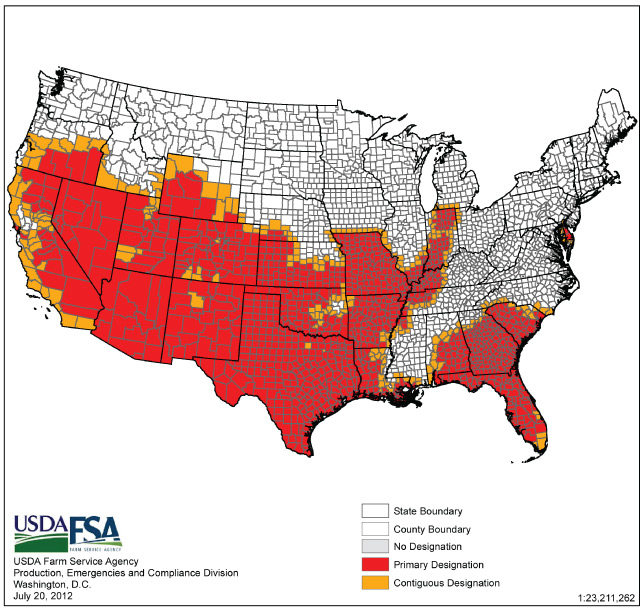
USDA Secretarial Drought Designations by County, July 20, 2012

With 62 percent of U.S. farms currently affected by nationwide drought conditions, USDA Secretary Tom Vilsack announced today several ways in which the agency is attempting to make it easier for farmers and ranchers to get help.

“President Obama and I are committed to getting help to producers as soon as possible and sustaining the success of America’s rural communities through these difficult times,” said Vilsack. “Beginning today, USDA will open opportunities for haying and grazing on lands enrolled in conservation programs while providing additional financial and technical assistance to help landowners through this drought. And we will deliver greater peace of mind to farmers dealing with this worsening drought by encouraging crop insurance companies to work with farmers through this challenging period.”

The assistance announced uses the Secretary of Agriculture’s existing authority to help create and encourage flexibility within four USDA programs: the Conservation Reserve Program (CRP), the Environmental Quality Incentives Program (EQIP), the Wetlands Reserve Program (WRP), and the Federal Crop Insurance Program.

[Read more…]

Filed Under: Blog Tagged With: Crop Insurance, CRP, Drought, EQIP, Tom Vilsack, USDA

« Previous Page
Next Page »
  • Email
  • Facebook
  • RSS
  • YouTube

Latest News from the Ohio & National Farmers Union

OFU Rallies for Rural Schools

Fair School Funding Plan Integral for Rural Public Schools COLUMBUS – The League of Women Voters of Ohio and Ohio Farmers Union held a Statehouse … Read More

Public Schools Build Connections in Rural Communities. Vouchers Tear Them Down.

by Melissa Cropper, president, Ohio Federation of Teachers This op-ed was orignally published on Barn Raiser: Rural communities depend on … Read More

National Farmers Union Week of Action for Strong Farm Bill

National Farmers Union (NFU) today concluded the Week of Action that gathered more than 100 farmers from across the country to the halls of Congress … Read More

How Do Tariffs Affect Family Farms?

A Talk in Kent, Ohio with Ohio Farmers Union and Others Have you noticed the price of eggs? Who hasn’t! How do government actions and tariffs … Read More

Check Out the Entire Blog

NATIONAL FARMERS UNION

Click to Take Action


Contact

Ohio Farmers Union
P.O. Box 363
1011 N. Defiance Street
Ottawa, Ohio 45875
Phone: (419) 523-5300
Toll Free: (800) 321-3671

Copyright Ohio Farmers Union© 2026 | Site by: RCS Communications


Loading Comments...