Ohio Farmers Union

Serving Family Farmers and Consumers Since 1934


United to Grow Family Agriculture Since 1934

  • About
    • The Farmers Union Triangle
    • Vision
    • OFU Leadership
  • Issues
    • 2020 Virtual Lobby Days
    • OFU Policy & NFU Policy
    • 2019 Lobby Day Registration
    • Get Involved!
    • NFU Climate Leaders
  • Education
    • 2019 OFU Essay Contest
    • Ohio Farmers Union Scholarships
    • Farm Safety
    • Renewable Energy Curriculum
  • Insurance
    • Hastings Mutual Insurance Co.
    • Health & Other Offerings
    • Ohio BWC Group Coverage
  • Join Us
    • Member Benefits
    • Insurance
  • Blog

Video: Nat Gas boom – busy laundromats & increased homelessness

September 29, 2011 By Ron Sylvester Leave a Comment

I spent a few hours at the Farm Science Review at Ohio State University’s Molly Caren Agricultural Center in London last week. Along with OFU President Roger Wise and OFU Executive Director Linda Borton, I attended a panel discussion put on by four OSU faculty members whose research and teaching revolve around rural economics, development and environmental issues. I hope to post, in this space soon, the entirety of the panel discussion after I get a few audio things fixed with the recording.

After the panel, I asked OSU Assistant Prof. Mike Lloyd who is based in Noble County as part of the OSU Extension Service. Lloyd has seen the natural gas boom begin in Ohio with an increase in mineral rights lease activity. Since he and others knew the gas rush was coming, he has also observed what has happened on the other side of the border in Pennsylvania and has spent time talking to local officials there about the economic impacts of the gas industry. Lloyd has also been providing some educational opportunities for eastern Ohio landowners on what to expect from the process of negotiating mineral rights on their land.

[Read more…]

Filed Under: Blog Tagged With: Farm Science Review, Fracking, Mike Lloyd, Natural Gas, Ohio, Ohio Farmers Union, OSU Extension

Ag News Update – September 29, 2011 – Fracking, Big Ag, & Other Matters …

September 29, 2011 By Ron Sylvester Leave a Comment

Dispatch does in-depth on Ohio natural gas drilling

The Columbus Dispatch has just finished a three-day series on the natural gas boom that is just beginning in Ohio. As politicians are hellbent for jobs at seemingly any cost and friendly representatives from multinational oil and gas corporations knock at rural landowners’ doors, precious few of us are taking a moment to consider the long view regarding the exploitation of the Marcellus and Utica natural gas formations deep below much of the eastern half of Ohio. As evidence that some newspapers are still willing to expend resources on investigative or in-depth coverage of an important issue, the Dispatch has run a series of stories shedding light on the gas industry and its record in other states, what’s happening in Ohio with mineral rights and leasing, the hows and whys of hydraulic fracturing or ‘fracking,’ and what oversight (actually, lack thereof) we can expect from state and federal officials.

Click Here for The Columbus Dispatch Series: Deep Pockets – Oil and Gas Deposits in Ohio

Ohio’s livestock care standards take effect today

Hannah Report

Comprehensive livestock standards created by the 13-member Ohio Livestock Care Standards Board will become effective Thursday, Sept. 29 when Ohio Department of Agriculture Director Jim Zehringer signs the final administrative order at a special ceremony starting at 2:30 p.m. in Fort Recovery. This will conclude two-months of outreach efforts by the agriculture department and Ohio’s farm organizations to inform Ohioans raising or caring for livestock about the new rules.

The Ohio Constitution required the establishment of comprehensive livestock care standards following passage of state Issue 2 in 2009. The ballot initiative specified creation of the Ohio Livestock Care Standards Board with the responsibility of obtaining industry and public input in developing livestock rules for alpacas, beef, dairy, goats, horses, llamas, pork, poultry, sheep and veal.

The board sought to create comprehensive livestock care standards that also support the state’s overarching policies to promote safe and affordable food, help prevent the outbreak of both animal and human diseases, and encourage local food production.

Members of the Ohio Livestock Care Standards Board and representatives of Ohio’s agricultural community devoted 18 months to developing and vetting the most comprehensive livestock care standards in the nation, said Zehringer.

“States from around the country are now looking towards Ohio’s leadership in developing these new standards,” he said.

All rules affecting the care of dairy, beef, swine, turkeys, broilers, sheep, goats, alpacas, llamas, and equine standards were approved by the General Assembly’s Joint Committee on Agency Rule Review (JCARR) before the summer legislative recess.

Group fighting “Big Ag” label is — Big Ag

New York Times

LAST week, a new public-relations campaign about agriculture got off to a splashy start. With full-page ads in newspapers and panel discussions live-streamed on the Internet, the newly formed U.S. Farmers and Ranchers Alliance began what it called a bid to “reshape the dialogue” about the American food supply.

“When did agriculture become a dirty word?” the Alliance asks on its Web site.

Chris Galen, a founding member of the group and head of communications for the National Milk Producers Federation, said, “There is a feeling across the board in agriculture that Americans have concerns about the food supply, and those are best addressed by farmers.”

To assure Americans that food is safe, abundant and affordable, farmers can use their voices and faces to fight the label “Big Ag,” the organization’s leaders say. But the group’s members include the largest agriculture marketing groups in the country, with billions of dollars to spend. They include the American Egg Board (“The Incredible Edible Egg”), the National Milk Producers Federation (“Got Milk?”) and the National Pork Board (“The Other White Meat”).

Its $11 million annual budget will come partly from mandatory marketing fees that the Department of Agriculture helps collect from farmers, and from corporations like Monsanto, the producer of genetically engineered seed, and DuPont, a major producer of chemical pesticides. Each company has committed to an annual contribution of $500,000.

Yet Bonnie West, a spokeswoman for the American National Cattlewomen, a booster group for beef consumption, said her members felt like “small potatoes” in the national debate over food.

The “big potatoes” for the group seem to be advocates and authors like Eric Schlosser (“Fast Food Nation”) and Michael Pollan (“The Omnivore’s Dilemma”), and the filmmaker Robert Kenner (“Food, Inc.”), whose work has criticized industrial agricultural practices like huge feedlots, tight confinement of animals, the widespread use of hormones and antibiotics and the billions of dollars in federal subsidies that they say support an otherwise unsustainable system.

It is a source of pride for their allies that there is now a perceived need for an organized response to their critiques.

Read More

ISU meteorologist says expect cold winter

agriculture.com

It’s not far off…and, if you were a fan of last winter’s weather, you’re in luck. But, if your snowblower needs repairs, you might want to get those taken care of before Old Man Winter arrives.

Many signs point to a likely repeat of last winter’s conditions, with cold temperatures and above-average precipitation in much of the Midwest and drier conditions in the Plains, says Don Keeney, meteorologist with MDA EarthSat Weather. Look for one difference from last year, though.

“It should be noted that the coldest conditions should occur earlier in the winter, with December and January being the colder time periods,” Keeney says.

The reason for the repeat in the winter outlook: The La Nina system that was supposed to be gone by now will likely stay in place through March, says Iowa State University (ISU) Extension Ag meteorologist Elwynn Taylor. La Nina is characterized by colder winter temperatures and the potential for a lot more volatile swings in the mercury than normal.

“A year ago, we had one of the 3 strongest La Ninas in the last 100 years. It did a lot of the things we expected it to do, both in the summer and winter,” Taylor says. “Now, we’re seeing it restrengthening. Not as harsh or extreme, but similar to last year.

“So yes, the probability looks like a replay of last year, maybe just not as extreme. But, let’s just say it wouldn’t be smart to do without your snowblower if you are a person who gets tired of shoveling snow.”

Read More

Report: Emergency food pantries have become a mainstay in many people’s diets

Associated Press

Rosalinde Block receives $241 a month in food assistance for her and her 18-year-old son, to add to the money coming in from the piano lessons she teaches and the art commissions she gets. In one of the world’s most expensive cities, it’s not enough.

“That goes pretty fast,” said Block, 59, of the amount she got for September, “it was already gone by the 12th or the 15th.”

So Block, who lives on Manhattan’s Upper West Side, adds to it with visits every other month to a food pantry in nearby Harlem, where she’ll get some chicken or milk, or some ingredients for soup or a few other meals. It’s been like this for a couple of years.

A report released Wednesday by Feeding America, a hunger-relief organization, finds that food banks that were originally created to serve as stop-gap emergency food providers are now taking a long-term, chronic role for Americans turning to them routinely to get enough to eat.

The organization’s Hunger in America 2010 report, the “Food Banks: Hunger’s New Staple,” found through data compiled in 2009 that 18 percent of those surveyed said they used food pantries six to 11 months of the previous year, while 36 percent they used them every month.

The survey also found that among those 65 years and older, 56 percent went to a food pantry every month. And even those receiving aid in the form of supplemental nutrition money still needed more help, with 58 percent of them being frequent or monthly users. “Those dollars don’t go very far,” said Vicki Escarra, president of the Chicago-based Feeding America.

Read More

Crackdown on excessive speculation in commodities markets stymied at CFTC

Reuters

The U.S. futures regulator delayed a final vote on controversial measures to crack down on excessive speculation in commodity markets because it lacks the three votes needed for approval, sources familiar with the situation told Reuters on Wednesday.

The U.S. Commodity Futures Trading Commission announced on Tuesday it was delaying by another two weeks to October 18 its meeting to consider the long-awaited rule on position limits. It was the second time a vote had been postponed.

The disagreements hinge on some of the smaller, seemingly less-contentious elements of the plan, not on the areas in which the CFTC has yielded to industry complaints.

This may suggest that Chairman Gary Gensler does at least have in principle an agreement on the need to impose limits on energy and metals markets, something several commissioners have questioned.

Two sources familiar with the agency’s rule-making said the CFTC commissioners and staff were working on ironing out a myriad of differences, including details of conditional limits — which allow for a higher limit in the spot month in a cash-settled contract than in a physically deliverable contract — as well as the timing of imposing the limits.

“He doesn’t feel like he has the votes,” one source familiar with the CFTC’s thinking told Reuters.

Read More

 Farmers group backs plan to overhaul dairy policy

Associated Press

A leading dairy farmers group threw its support Monday behind a proposed overhaul of federal milk subsidies after its creator agreed that participation in a program limiting milk production in hard times would be voluntary.

The plan developed by Minnesota Rep. Collin Peterson would replace current federal dairy programs with new ones intended to do a better job of protecting farmers from the kind of crisis they suffered during the recession in 2009, when milk prices plunged, feed costs skyrocketed and hundreds were forced out of business.

Peterson’s original plan called for limits on how much milk farmers could produce when the difference between milk prices and the cost of producing milk, as determined by feed prices, fell to a certain level. The intent was to balance supply and demand.

Some farmers objected to the federal government limiting how much milk they could produce, saying the answer to problems facing the dairy industry was less government interference, not more.

After getting feedback for several months, Peterson, the ranking Democrat on the House Agriculture Committee, agreed to make participation in the so-called dairy market stabilization program voluntary.

But, farmers would have to participate in that program to qualify for another, more popular one that works like an insurance system. In effect, dairy producers would pay premiums in good times that would enable them to collect more generous government payouts in bad times. If they chose to pay nothing, they would get a minimal subsidy.

Read More


Filed Under: Blog Tagged With: Columbus Dispatch, Commodities Markets, Fracking, Hunger, Natural Gas, Ohio

NE Ohio Farmers Union Leaders to Hold Informational Meeting on Fracking Tonight

September 26, 2011 By Ron Sylvester Leave a Comment

Family Farmers Sponsor Public Meeting on Fracking in NE Ohio

COLEBROOK – Leadership of the Ashtabula, Geauga and Lake Counties Farmers Union and the Trumbull County Farmers Union will hold an information sharing meeting tonight on the subject What Fracking Will Mean to Us.

The meeting will be held at the Colebrook Community Center at the corner of SR 322 and SR 46 in Ashtabula County from 7 to 9 p.m. There will be a question and answer period. The event is free and open to the public.

Fracking is short for hydraulic fracturing – a drilling method employed to extract natural gas or oil from wells in hard rock strata thousands of feet below the ground. Fracking will be used during the drilling of the Marcellus and Utica shales in Eastern Ohio for natural gas extraction.

Joe Logan, Trumbull County Farmers Union president and director of agricultural issues for the Ohio Environmental Council will discuss possible impacts of fracking on agriculture and natural resources with a focus on fresh water supplies.

Vanessa Pesec, president of the Network for Oil and Gas Accountability and Protection (NEOGAP), will present a detailed lecture on what fracking will mean to us as individuals, landholders and communities. Pesec will also talk about what landholders should look for in a fair lease should they decide to lease their mineral rights.


Filed Under: Blog Tagged With: Ashtabula County, Fracking, Joe Logan, Mardy Townsend, Natural Gas, NEOGAP, Vanessa Pesec

Event: NE Ohio Farmers Union Members to Hold Fracking Information Meeting

September 23, 2011 By Ron Sylvester Leave a Comment

What Fracking will Mean to Us

Monday, September 26, 2011

7-9pm

Colebrook Community Center

Colebrook (northeast corner of state routes 322 and 46)

Ashtabula, Geauga, Lake Counties Farmers Union and Trumbull County Farmers Union are presenting a joint educational meeting: What Fracking will Mean to Us? Fracking is short for hydraulic fracturing – a drilling method employed to extract natural gas or oil from wells in hard rock strata thousands of feet below the ground. Fracking will be used during the drilling of the Marcellus and Utica shales in Eastern Ohio for natural gas extraction.

[Read more…]

Filed Under: Blog Tagged With: Ashtabula, Fracking, Geauga, Joe Logan, Lake Counties Farmers Union, Mardy Townsend, Natural Gas, NEOGAP, Ohio Farmers Union, Trumbull County Farmers Union, Vanessa Pesec

VIDEO: Vilsack addresses National Farmers Union gathering

September 23, 2011 By Ron Sylvester Leave a Comment

The National Farmers Union sponsored its annual legislative “Fly-In” in Washington, D.C. recently. The Fly-In is an opportunity for state Farmers Union leadership and rank and file members to descend on Capitol Hill and visit with legislators on family farming issues.

Secretary of Agriculture Tom Vilsack addressed members during the Fly-In. The video was produced by USDA – fake news alert – but we thought we would share it with you in any event. What would be great is if the USDA would make available Vilsack’s full appearance before the National Farmers Union without the slick edits and fake news report vibe – now that would be information … Take this for what it’s worth:

Filed Under: Blog

Ag News Roundup – September 23, 2011 – Harvest, Fracking among topics

September 23, 2011 By Ron Sylvester Leave a Comment

A few things of interest from the national & Ohio media:

Kasich advocates switching state vehicles to nat gas, says “We cannot stop fracking”

Columbus Dispatch

Ohio might join with neighboring states and convert government vehicle fleets to run on natural gas, which would boost demand for gas from the region’s shale formations, Gov. John Kasich said yesterday.

The governor spoke about the plan in the closing address of his two-day energy conference. He also said his office will announce a comprehensive energy policy by spring, although he gave few details about what it might include.

Kasich said he spoke with Pennsylvania Gov. Tom Corbett about the natural-gas-fueled vehicle idea, and members of his staff have brought up the idea with counterparts in Indiana and Michigan.

Read More

Nat Gas industry says 200,000 jobs could result from Ohio shale gas

 Dayton Daily News/AP

Natural gas trapped in two shale formations beneath Ohio could mean thousands of new jobs, if activity in other states is any indication.

In Pennsylvania, which sits on one of the same shale formations as Ohio, gas and oil industries hired 72,000 people between the fourth quarter of 2009 and the first quarter of 2011, according to Pennsylvania Department of Labor & Industry statistics.

The number of new hires for the core gas industries — extraction, drilling and pipeline work — is smaller but still doubled to 18,837 from the fourth quarter of 2007 to the fourth quarter of 2010.

Tim McElhinny, an analyst with the Pennsylvania Labor Department, said all hires can’t be attributed to new drilling, but there are so many of them that a portion must be caused by work on the Marcellus shale.

Read More

Industry says gas boom could produce economic miracle

The Plain Dealer

… The new jobs study, contained in a 92-page economic impact analysis, was prepared by economic research company Kleinhenze & Associates of Cleveland for the Ohio Oil & Gas Energy Education Association.

The conclusions are based on propriety information obtained from large gas and oil corporations that jockeyed for months to lease mineral rights from rural land owners. Marietta College, Ohio State University, Central Ohio Technical College and Zane State College contributed to the data analysis.

Among the study’s main conclusions:

• Over the next five years, oil and gas producers are expected to spend $34 billion in exploration and development, pipelines, royalty payments to landowners and other leasing expenditures.

• New jobs would start slowly — 4,614 jobs this year, increasing to 22,297 next year — and then mushroom by tens of thousands from 2013 through 2015, culminating at an estimated 204,520 jobs by 2015.

• Wages, salaries and personal income attributable to the production would soar to an estimated $12 billion per year, including $1.6 billion in royalties, by 2015.

• Annual tax revenues, including income, property, commercial activity and “severance” taxes or royalties tied to the production would total $478.9 million by 2015.

Read More

Corn Yields Coming in Mixed

agriculture.com

Combines are rolling in the Corn Belt. So, what’s the crop making so far?

Yields are all across the board as harvest gets rolling in corn and soybean country. Corn moisture levels are still on the high side in a lot of areas, though, keeping harvest progress a little on the slow side.

“Things are moving slow. Corn is not drying down very fast, if at all it seems,” says Benton, Illinois, farmer Kelly Robertson. “Working on odds and ends between trying to haul some corn out and it doesn’t seem like I am getting much accomplished.”

But, where harvest activity has been able to pick up, the results are mixed.

“We are running here in northeast Kansas. Corn is pretty good — above average from what I was expecting,” says Seneca, Kansas, farmer Rod Tangeman says. “So far, we have had fields go 168 [bushels/acre], 170, 105, 142, 163 and 158.”

Read More

Obama would cut ag programs

agriculture.com

When it comes to farm policy, Congress often ignores White House proposals. It passed the 2008 Farm Bill over President George W. Bush’s veto and it’s possible both parties will ignore some of the ideas put forth Monday in President Barack Obama’s Economic Growth and Deficit Reduction Plan,

Obama didn’t ignore agriculture, however. He wants to eliminate or reduce these ag programs:

  • Eliminate Direct Payments. The White House says they’re not needed at a time of high farm income, adding that “Economists have shown that direct payments have priced young Americans out of renting or owning the land needed to enter into farming.” It would save $3 billion per year.
  • Crop Insurance. The Administration is looking for more cuts here. It says currents costs are $8 billion per year, with $2.3 billion going to insurance companies and $5.7 billion to farmers as premium subsidies. USDA has already trimmed $600 million a year from support for insurers and hasn’t touched subsidies of farmer premiums. Obama’s deficit cutting plan would trim another 200 million a year from insurance companies, arguing that they would still have a return on investment of 12%. Farmer premium subsidies for coverage at the 50% catastrophic level would not change but premium subsidies on higher levels over coverage would be shaved by two basis points, or $200 million per year (a 3,.5% cut from current levels).
  •  Conservation. Obama would cut conservation programs by $200 million a year “by better targeting conservation funding to the most cost-effective and environmentally- beneficial programs and practices.” Even with those cuts, conservation assistance is projected to grow by $60 billion over the next 10 years.

Read More

Farm lobby’s power withers as programs face cuts

Politico

Washington’s debt crisis brings American agriculture to a crossroads this fall and no other sector of the economy may have more to gain or lose from the debate in Congress over deficit reduction.

With record exports predicted for 2011, farmers begin with a proven self-interest in stable world markets, but their very success makes them all the more vulnerable now to deep cuts from the federal subsidies so synonymous with agriculture for decades.
Read More

Filed Under: Blog Tagged With: Fracking, John Kasich, Natural Gas, Ohio, Rural Economic Development

NFU President says trade with Cuba makes sense

September 16, 2011 By Ron Sylvester Leave a Comment

WASHINGTON (Sept. 15, 2011) – National Farmers Union (NFU) President Roger Johnson issued the following statement after the U.S. Senate Appropriations Committee passed an amendment to allow direct cash transfers between U.S. and Cuban financial institutions by a vote of 20-10:

“NFU is encouraged that the Senate Appropriations Committee passed the amendment that would allow U.S. and Cuban financial institutions to directly transfer payments to each other. Currently those payments must be routed through a financial institution in another country, leading to additional fees and complications.

“NFU has long been a supporter of trade with Cuba. These self-imposed restrictions hurt our own domestic producers and make U.S. trade less competitive. The U.S. has exported $4 billion of agriculture goods to Cuba since 2000, and that number will grow with the elimination of this unnecessary trade barrier.

“At a time of high unemployment and stagnant economic growth, allowing direct cash transfers between the U.S. and Cuba provides a unique opportunity to create jobs and stimulate economic development in rural America. U.S. farmers and ranchers should be able to do business with customers in the United States’ backyard. It just makes sense. I encourage the full Senate to pass this amendment in its current form as quickly as possible.”


Filed Under: Blog Tagged With: Cuba, National Farmers Union, Roger Johnson, Trade

Five Ohio members of Congress receive award from NFU

September 14, 2011 By Ron Sylvester Leave a Comment

Five Ohio Members of Congress Recognized by NFU

(R-L) Sen. Sherrod Brown, Rep. Marcy Kaptur, Rep. Marcia Fudge, Rep. Betty Sutton and Rep. Tim Ryan

Five Ohio members of Congress were awarded the Golden Triangle Tuesday by the National Farmers Union for demonstrating leadership and supporting policies that benefit family farmers, rural residents, ranchers and fishermen.

The five Ohioans are:

  • U.S. Sen. Sherrod Brown, D-Ohio
  • U.S. Rep. Marcy Kaptur, D-Toledo
  • U.S. Rep. Marcia Fudge, D-Warrensville Heights
  • U.S. Rep. Betty Sutton, D-Copley
  • U.S. Rep. Tim Ryan, D-Niles

“Recipients of the Golden Triangle Award have been strong advocates for family farmers and ranchers, and exhibit similar principles and policies to Farmers Union,” said NFU President Roger Johnson. “We are pleased to honor those who have proven to be true allies of our organization and our members across the country.”

Roger Wise, president of the Ohio Farmers Union said, “These members of Congress get it. The deck is stacked against family farmers and rural communities when it comes to policy and legislation. All five of these representatives have worked to ensure that our local economies are not left out in the cold when the big money interests show up on Capitol Hill.”

[Read more…]

Filed Under: Blog Tagged With: Family Farmers, Golden Triangle, National Farmers Union, Ohio Farmers Union, Rep. Betty Sutton, Rep. Marcia Fudge, Rep. Marcy Kaptur, Rep. Tim Ryan, Roger Johnson, Roger Wise, Sen. Sherrod Brown

Zumbrink gains national recognition for working to keep locals involved in farm program decisions

September 12, 2011 By Ron Sylvester Leave a Comment

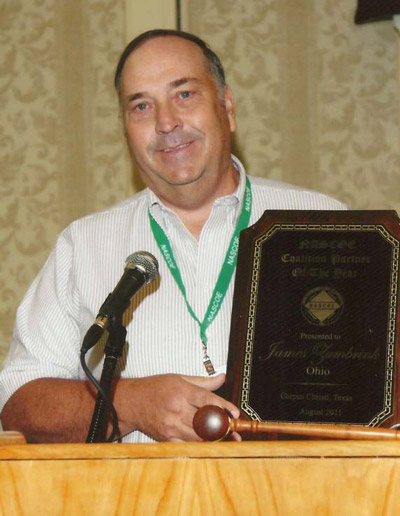
Jim Zumbrink with Award

Jim Zumbrink, NASCOE Coaltion Partner of the Year

Ohio Farmers Union member Jim Zumbrink was recognized at a recent national convention of Farm Service Agency county employees for his work building coalitions among organizations that advocate maintaining local contributions to federal farm program decision-making.

Zumbrink was named Coalition Partner of the Year by the National Association of FSA County Office Employees at the group’s 2011 convention in Corpus Christi, Texas. The award was for his involvement and work between NASCOE and the National Association of Farmer Elected Committees.

“Jim Zumbrink has always been a great supporter of Ohio FSA employees and the county committee system and on behalf of the Ohio Association of FSA Employees we appreciate his unwaivering committment to make FSA better for our employees and the producers we serve,” said Mark VanHoose, president of the Ohio Association of FSA County Employees.

“Jim not only commits his time but his own resources to travel to NASCOE and NAFEC events because he so strongly beliefs in a farm program delivery system that has grassroots input from the local level and we wanted to recognized his dedication through this award,” VanHoose said.

[Read more…]

Filed Under: Blog Tagged With: Darke County, FSA, Jim Zumbrink, NAFEC, NASCOE, OASCOE, Ohio Farmers Union

Commentary: Budget Austerity – At the Point of Diminishing Return

September 7, 2011 By Ron Sylvester Leave a Comment

by Joe Logan, OFU Executive Committeeman

As the global economy teetered at the point of collapse in 2008, governmental leaders in the administrations of both the out-going President Bush and the in-coming President Obama, took the types of actions which virtually all economists advocated. They made massive investments in crucial financial and industrial corporations that were deemed to be crucial to our economic survival.

No good deed goes unpunished.

[Read more…]

Filed Under: Blog Tagged With: Corporations, Deficits, Federal Budget, Joe Logan, Ohio Farmers Union, State Budgets

« Previous Page
Next Page »
  • Email
  • Facebook
  • RSS
  • YouTube

Latest News from the Ohio & National Farmers Union

OFU Rallies for Rural Schools

Fair School Funding Plan Integral for Rural Public Schools COLUMBUS – The League of Women Voters of Ohio and Ohio Farmers Union held a Statehouse … Read More

Public Schools Build Connections in Rural Communities. Vouchers Tear Them Down.

by Melissa Cropper, president, Ohio Federation of Teachers This op-ed was orignally published on Barn Raiser: Rural communities depend on … Read More

National Farmers Union Week of Action for Strong Farm Bill

National Farmers Union (NFU) today concluded the Week of Action that gathered more than 100 farmers from across the country to the halls of Congress … Read More

How Do Tariffs Affect Family Farms?

A Talk in Kent, Ohio with Ohio Farmers Union and Others Have you noticed the price of eggs? Who hasn’t! How do government actions and tariffs … Read More

Check Out the Entire Blog

NATIONAL FARMERS UNION

Click to Take Action


Contact

Ohio Farmers Union
P.O. Box 363
1011 N. Defiance Street
Ottawa, Ohio 45875
Phone: (419) 523-5300
Toll Free: (800) 321-3671

Copyright Ohio Farmers Union© 2026 | Site by: RCS Communications


Loading Comments...