Agriculture Secretary Tom Vilsack has announced a two-month extension for emergency grazing on Conservation Reserve Program (CRP) acres, freeing up forage and feed for ranchers as they look to recover from this challenging time. This flexibility for ranchers marks the latest action by the U.S. Department of Agriculture to provide assistance to producers impacted by the drought, which has included opening CRP and other conservation acres to emergency haying and grazing, lowering the interest rate for emergency loans, and working with crop insurance companies to provide flexibility to farmers.
Ohio Swine Flu Update – August 19, 2012
As the summer county and state fair season turns into the fall season, one thing has been on all livestock exhibitors, public health and ag officials and patrons minds: Swine Flu.
Ohioans began to hear about Swine Flu in early August when some patrons of the Butler County Fair were diagnosed with the virus, H3N2v. Some swine being exhibited at the fair were found to be sick with the virus and media and state agency reports at the time indicated most of the human victims were children who had come into contact with infected swine. The U.S. Centers for Disease Control and the Ohio Department of Health both report that kids are especially susceptible to Swine Flu because they haven’t had time to develop antibodies against the virus.
So far in Ohio there have been 72 cases of the flu in humans with most of them directly attributed to contact with pigs or hogs. There have been less than 10 hospitalizations, with all of those patients treated and released. There have been no deaths from this summer flu outbreak.
Public health officials at the state and federal level are continuing to monitor the situation closely, however. For now, there is no evidence that the virus is transmittable from human to human contact. The virus would need to mutate in one of its human victims in just the right way to spread from human to human and if it did, it would become a bigger problem for public health.
There are still several county fairs to occur around Ohio and the Ohio Dept. of Agricuture is teaming up with ODH to strengthen health precautions at swine exhibits around the state. At every county fair there will be daily health checks of pigs and hogs by a veterinarian. Several animals have already been removed from fairs, including two removed from the recent Ohio State Fair. ODA and ODH officials or their local designees will also be meeting face to face to with all swine exhibitors to discuss the virus, what to look for in their animals and the precautions that they and fair goers should take around livestock barns.
How does the USDA disaster declaration process work?
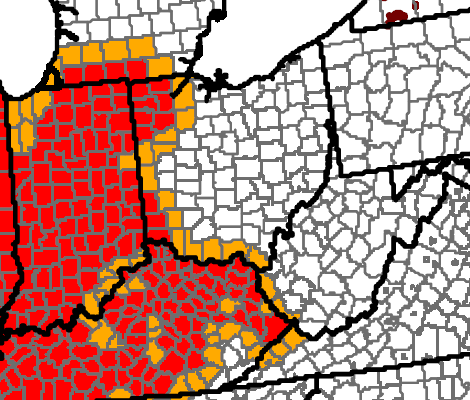 For the past several weeks, U.S. Secretary of Agriculture Tom Vilsack has announced dozens or even hundreds of additional counties across the U.S. that have been declared primary drought disaster areas. What’s it mean? If you’re a farmer worried about crop loss or early livestock sales, can you get help?
An agricultural disaster declaration for your county – or a county adjacent to yours – means that USDA guaranteed, low-interest emergency loans will be available to help farmers and ranchers meet cashflow requirements in the face of lost crops or livestock. The loan program is administered through USDA’s Farm Service Agency, meaning you can assistance at the state or local level. Farmers and ranchers in declared counties can get help. In some cases, there may be FSA emergency programs available in addition to the emergency loans.
Latest U.S. Drought Monitor: Midwest
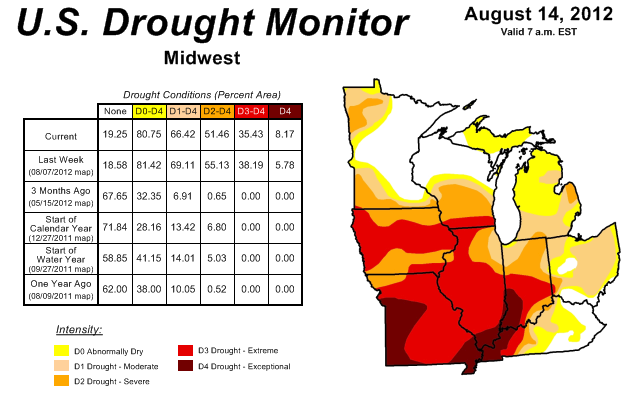 As of the last report from the federal government earlier this week, you can see that Ohio is mostly still in the midst of “moderate drought” conditions. Compare this to conditions over the past six weeks in the midwest. (Link takes you to a six-week animation of the Drought Monitor.)
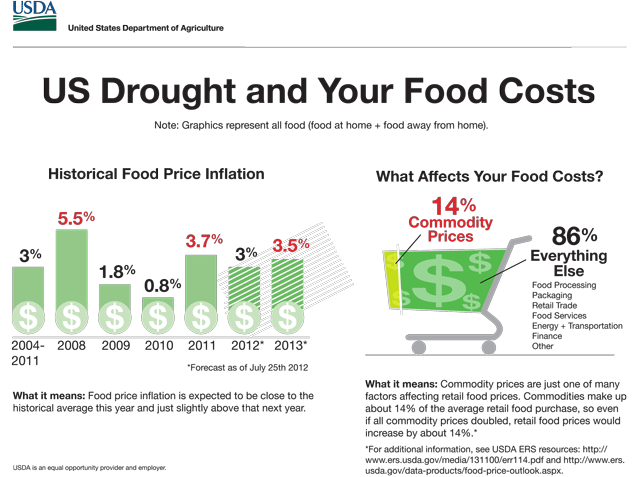
Infographic: The U.S. drought & the cost of food
The USDA makes the point with this infographic that commodity prices – the corn, beans, grain and proteins from fields and pastures – are a low portion of the overall cost of your food. The National Farmers Union and OFU have been making this case for years via regular publication of the “Farmer’s Share” of the retail food dollar.
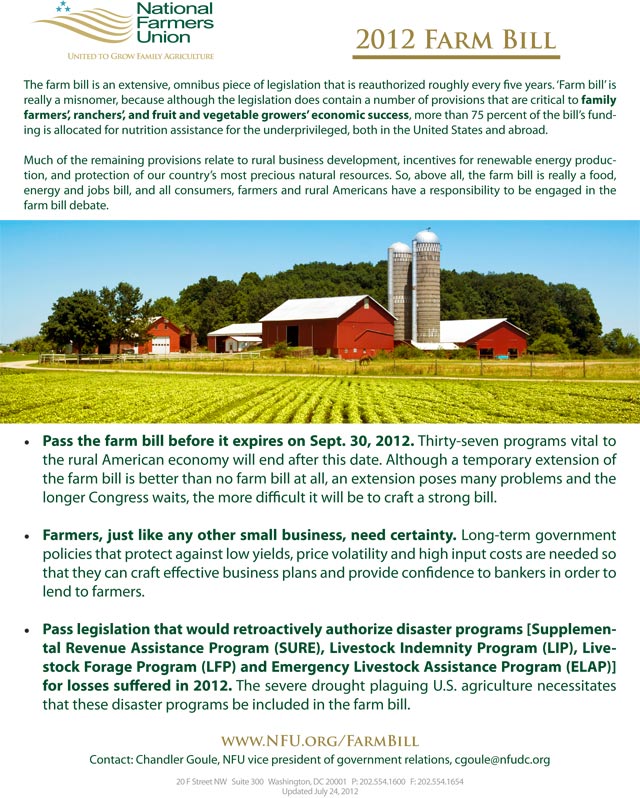
What can you be doing about the Farm Bill?
The U.S. Senate has done its job. The House of Representatives Ag Committee has done its job. Now it’s time for Speaker John Boehner and the rest of the House majority leadership to do theirs: Bring the 2012 Farm Bill to the House floor for action.
There’s a job for you to do as well. Contact your member of Congress and tell him or her that it’s never been more important for U.S. farm policy to move forward in a bipartisan manner. U.S. farmers and ranchers are battling the worst drought since WWII, the national economic recovery is weak and farmers need certainty as much as multi-national corporations and the big banks on Wall Street. Don’t let them forget the farmers. Below you will find some information from the National Farmers Union. Read it and think about how the lack of a Farm Bill passed by September 30 would affect your own family farm. Tell your member of Congress about that and ask them to support efforts to move the bipartisan bill passed by the House Ag Committee to the floor.
USDA $170 million meat purchase to help farmers and ranchers affected by drought
USDA Secretary Tom Vilsack said Monday that the Obama Administration remains committed to pulling out all the stops for U.S. farmers and ranchers affected by the drought and followed up with an announced purchase of $170 million in meat products.
The purchase will include pork, poultry, lamb and fish. USDA hopes it will help producers having difficulty raising livestock in drought conditions. The meat purchases will go to the nation’s food banks, the Supplemental Nutrition Assistance Program and other U.S. safety net programs that fight hunger.
“President Obama and I will continue to take swift action to get help to America’s farmers and ranchers through this difficult time,” said Vilsack. “These purchases will assist pork, catfish, chicken and lamb producers who are currently struggling due to challenging market conditions and the high cost of feed resulting from the widespread drought. The purchases will help mitigate further downward prices, stabilize market conditions, and provide high quality, nutritious food to recipients of USDA’s nutrition programs.”
USDA’s intention is to purchase up to $100 million of pork products, up to $10 million of catfish products, up to $50 million in chicken products, and up to $10 million of lamb products. Through the Emergency Surplus Removal Program, USDA can use Section 32 funds to purchase meat and poultry products to assist farmers and ranchers who have been affected by natural disasters. The pork, lamb and catfish purchases are based on analyses of current market conditions. A major factor affecting livestock producers is the value of feed, which is currently running high because of the drought.
[Video] Ohio Swine Flu Update from State Depts of Ag, Health
Ted Strickland sports OFU briefcase on travels for DNC
Ohio Farmers Union Presdent Roger Wise and his wife Sandra got a pleasant surprise traveling this summer – running into former Ohio Gov. Ted Strickland in Minneapolis. And guess what? Ted is still using his OFU briefcase 🙂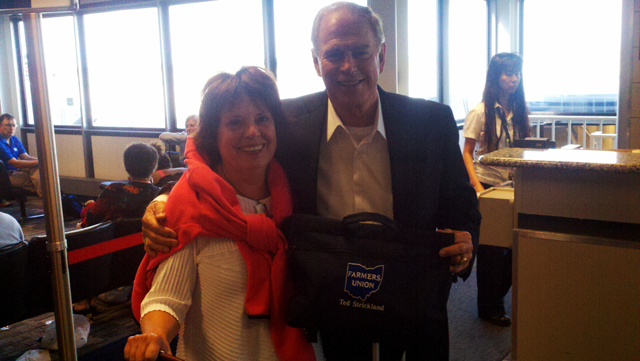
Vilsack: USDA focus remains doing everything to help farm and ranch families get through drought
The following is a column by USDA Secretary Tom Vilsack.
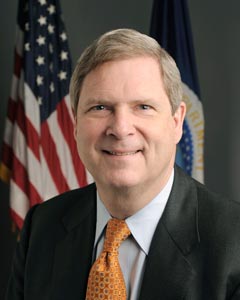
USDA Secretary Tom Vilsack
As drought continues to affect most of the country, our thoughts and prayers are with the thousands of farm families who have been affected by this disaster.
Earlier this summer the U.S. Department of Agriculture acted quickly to open conservation programs for emergency haying and grazing, lowered the interest rate for emergency loans, and worked with crop insurance companies to provide more flexibility to farmers.
On August 7, President Obama once again convened his White House Rural Council and announced several new measures the Administration is taking to help those impacted by the drought.
These include providing $30 million in additional funding to help producers access water supplies and repair land; increasing capacity for lending to small businesses, including farms and ranches; and waiving certain requirements on trucks, to get more drivers on the road in the relief effort.
President Obama stressed the need for the entire Administration to continue looking at further steps it can take to help.
I also know that Americans who don’t live on the farm or ranch are wondering what the drought means for them.
While this is a difficult time for many producers, it’s important to understand that thanks to advances in farming technology, more diverse global markets, lower farm debt and a stronger rural economy, farmers and ranchers are better prepared to face drought than in past years.
We may yet see strong yields in many parts of the country – we won’t know until the harvest is done. But we can say with confidence that Americans should not see significant short-term food price increases, or price spikes at the grocery store, due to drought.