Ohio Farmers Union

Serving Family Farmers and Consumers Since 1934


United to Grow Family Agriculture Since 1934

  • About
    • The Farmers Union Triangle
    • Vision
    • OFU Leadership
  • Issues
    • 2020 Virtual Lobby Days
    • OFU Policy & NFU Policy
    • 2019 Lobby Day Registration
    • Get Involved!
    • NFU Climate Leaders
  • Education
    • 2019 OFU Essay Contest
    • Ohio Farmers Union Scholarships
    • Farm Safety
    • Renewable Energy Curriculum
  • Insurance
    • Hastings Mutual Insurance Co.
    • Health & Other Offerings
    • Ohio BWC Group Coverage
  • Join Us
    • Member Benefits
    • Insurance
  • Blog

Amish Growth

August 1, 2012 By Ron Sylvester Leave a Comment

From Hannah:

A new census of the Amish population in the United States (U.S.) estimates that a new Amish community is founded, on average, about every three and one-half weeks, and shows that more than 60 percent of all existing Amish settlements have been founded since 1990.

This pattern suggests the Amish are growing more rapidly than most other religions in the United States, researchers say. Unlike other religious groups, however, the growth is not driven by converts joining the faith, but instead can be attributed to large families and high rates of baptism.

In all, the census counts almost 251,000 Amish in the U.S. and Ontario, Canada, dispersed among 456 settlements, the communities in which members live and worship. The 1990 census estimated that there were 179 settlements in the United States.

If the growth of the Amish population continues at its current rate, the Ohio State University researchers predict that the census could exceed one million Amish and 1,000 settlements shortly after 2050, and these numbers will bring economic, cultural, social and religious change to the rural areas that attract Amish settlement.

Among the changes the researchers predict: Amish will buy up land vacated by farmers in rural areas close to community services, but the availability of farmland might not keep pace with population growth. This means many Amish men will likely look for nonfarm jobs such as woodworking and construction trades, which could affect land prices and potentially enhance local economies through the establishment of business startups.
Read the rest at the Hannah Report

Filed Under: Blog Tagged With: Amish

CRP Lands: Emergency Haying and Grazing for all Ohio counties

August 1, 2012 By Ron Sylvester Leave a Comment

Ohio Farm Service Agency (FSA) announced additional drought relief for Ohio’s livestock producers today. Secretary of Agriculture Tom Vilsack authorized the release of emergency haying and grazing lands for all Ohio counties for certain practices and acres enrolled in the Conservation Reserve Program (CRP).

USDA will allow acres under CRP to be used for haying or grazing under emergency conditions, for the following approve practices: Permanent Grasses and Native Grasses, Permanent Wildlife Habitat Noneasement, and Vegetative Cover (Grass) already established, the following practices are not eligible for haying and grazing Water Ways and acreage under the SAFE program. This will allow lands that are not yet classified as “under severe drought” but that are “abnormally dry” to be used for haying and grazing. This will increase available forage for livestock.

[Read more…]

Filed Under: Blog Tagged With: CRP, Drought, USDA

USDA announces Commodity Credit Corp. lending rates for August 2012

August 1, 2012 By Ron Sylvester Leave a Comment

WASHINGTON, Aug. 1, 2012 — The U.S. Department of Agriculture’s Commodity Credit Corporation (CCC) today announced interest rates for August 2012. The CCC borrowing rate-based charge for August 2012 is 0.250 percent, unchanged from 0.250 in July 2012. For 1996 and subsequent crop year commodity and marketing assistance loans, the interest rate for loans disbursed during August 2012 is 1.250 percent, unchanged from 1.250 in July 2012.

In accordance with the 2008 Farm Bill, interest rates for Farm Storage Facility Loans approved for August 2012 are as follows, 1.000 percent with seven-year loan terms, down from 1.125 in July 2012; 1.625 percent with 10-year loan terms, unchanged from 1.625 in July 2012 and; 1.875 percent with 12-year loan terms, unchanged from 1.875 percent in July 2012. The interest rate for Sugar Storage Facility Loans for August 2012 is 2.000 percent, down from 2.125 in July 2012.

Further program information is available from USDA Farm Service Agency’s (FSA) Financial Management Division at 202-772-6041.


Filed Under: Blog Tagged With: Commodity Credit Corp., Finance

State distributes casino tax money

August 1, 2012 By Ron Sylvester Leave a Comment

The state of Ohio has distributed the first tax collections from Ohio’s casino industry to local governments.

According to Hannah News Service, taxes are tallied quarterly and divided among Ohio’s 88 counties according to size. Casino host cities get an extra 5% of the gambling haul and counties with cities of 80,000 or more population must split their revenue with those cities.

The largest check this time went to Cleveland, with a host city check of over $648,000. (Cuyahoga County received a check for more than $500,000.) Vinton County, on the other end of the scale, received a check for nearly $12,000.

Filed Under: Blog Tagged With: Gambling, Ohio, Taxes

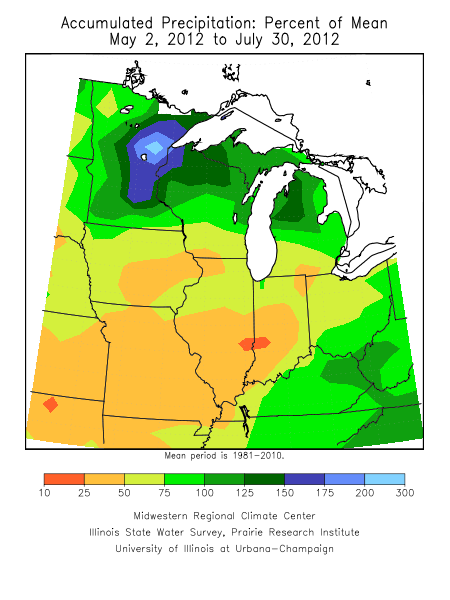
More than half of Ohio has had between 50-75% of average rainfall over 90 days

July 31, 2012 By Ron Sylvester Leave a Comment

Another online resource to add to your list of ways to follow information about the drought affecting most of Ohio is Midwest Climate Watch from the Midwestern Regional Climate Center (MRCC).

The MRCC is a cooperative effort of the National Climatic Center and the Illinois State Water Survey. The MRCC serves the nine-state Midwest region: Illinois, Indiana, Iowa, Kentucky, Michigan, Minnesota, Missouri, Ohio, and Wisconsin. They focus on research help to better explain climate and its impacts on the Midwest, provide practical solutions to specific climate problems, and development of climate information for issues such as agriculture, climate change, energy, the environment, human health, risk management, transportation, and water resources.

[Read more…]

Filed Under: Blog Tagged With: Cattle, Drought, Hay, Midwest Climate Watch, MRCC, Ohio, Ohio Farmers Union

NFU’s Johnson blasts Congress on idea to extend 2008 Farm Bill

July 30, 2012 By Ron Sylvester Leave a Comment

Wasn’t there a time in America when the good people who represent us in Congress could lay aside political differences and do serious public policy when the nation faced emergency? Wouldn’t you say that the worst U.S. drought since the 1950s might be just such an emergency?

Leaders in the U.S. House of Representatives think differently. The latest proposal is to lay aside the Senate Farm Bill (passed) and the House Farm Bill (through committee) and just extend the current law. Here’s what National Farmers Union President Roger Johnson said today on the subject:

[Read more…]

Filed Under: Blog Tagged With: 2008 Farm Bill, 2012 Farm Bill, National Farmers Union, Roger Johnson

UPDATE: U.S./Ohio Drought Online Resources

July 30, 2012 By Ron Sylvester Leave a Comment

According to the USDA’s Economic Research Service, 62 percent of U.S. farms are now affected by drought conditions which stretch across the country from Rhode Island to California in the continental U.S. and includes most of Hawaii.

In Ohio there are currently four counties in the state’s northwest corner with USDA drought designation: Williams, Defiance, Paulding and Van Wert. Ohio’s four counties are listed as “contiguous designations” as they are adjacent to four counties in Indiana which are counties with “primary” designations.

The ERS says on its website that it’s impossible to say exactly how much food prices will be impacted by the drought, but does say based on past experience and how inputs move through our system of food that consumers can expect the following:

  • Beef, pork, poultry and dairy prices will likely begin to be impacted in two months. Packaged and processed foods with corn and soybean inputs could take 10 to 12 months for full price impacts.
  • When herds are culled during droughts, there could be some short-term price reductions in certain meat products due to increased short-term supply.
  • Historically, if the farm price of corn increases 50 percent, then retail food prices as measured by the Consumer Price Index (CPI) increases by 0.5 to 1 percent. More generally, as an overall commodity price index increases, about 14 to 15 percent of that increase is passed on to retail prices for products that use that commodity as an ingredient.
  • Based on 2010 data 2/3 of U.S. crops and 2/3 of U.S. livestock are in drought areas.

A few online resources

  1. The USDA’s Drought Page – contains the latest news releases and other information from USDA focusing on agency actions and farmer assistance due to the drought.
  2. The U.S. Drought Monitor – is a multi-agency effort focused on recording the drought levels and severity across the U.S. The map on this page is related the severity of drought, not whether a particular county has been designated by USDA Secretary Tom Vilsack or any other official as in an emergency or other special status.
  3. The National Drought Mitigation Center – focuses on drought impacts and the science of droughts.
  4. The Office of the State Climatologist for Ohio – contains many links to climate and weather-related information regarding Ohio.
  5. Ohio Dept. of Agriculture Drought Information Page – contains links to information including SBA loan information for those affected by the drought.
  6. OSU Extension – Managing the Drought of 2012 – tons of information and links covering farm and home topics.
  7. Midwest Climate Watch – site contains lots of data and graphics regarding the drought, focuses only on the midwest.

Filed Under: Blog

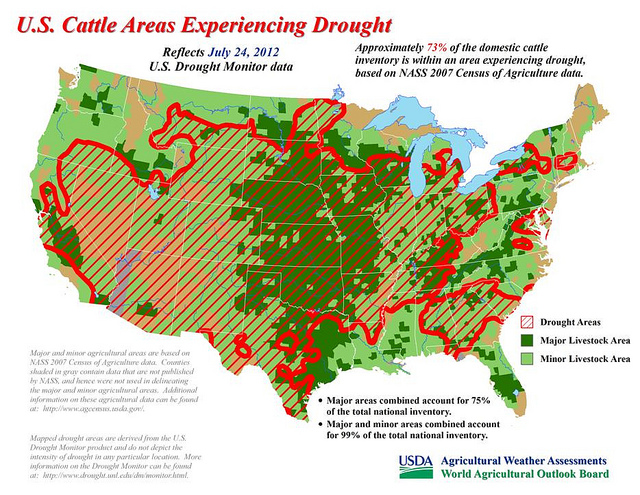
73% of U.S. cattle in regions experiencing drought conditions

July 30, 2012 By Ron Sylvester Leave a Comment

Filed Under: Blog Tagged With: Cattle, Drought

DROUGHT: Corn conditions in Ohio worse than nation as whole

July 30, 2012 By Ron Sylvester Leave a Comment

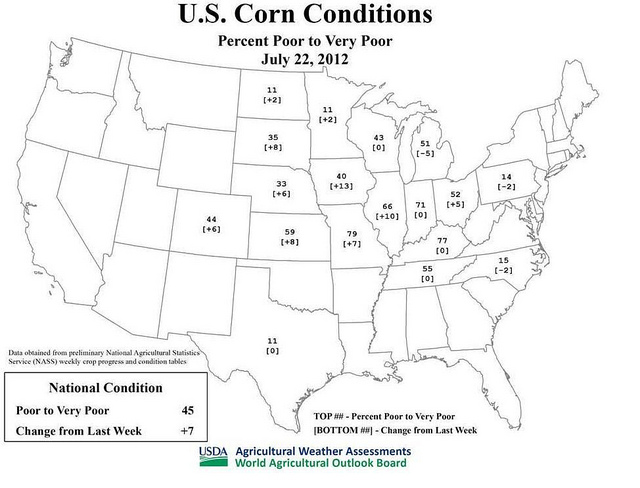
More than half of Ohio’s corn crop is rated poor to very poor for July – a number up 5 percent since last month. Nationwide, 45 percent of the corn crop is rated poor to very poor.

Filed Under: Blog Tagged With: Corn, Drought, Ohio

DROUGHT: Ohio soybean conditions match national average for ‘poor’ to ‘very poor’

July 30, 2012 By Ron Sylvester Leave a Comment

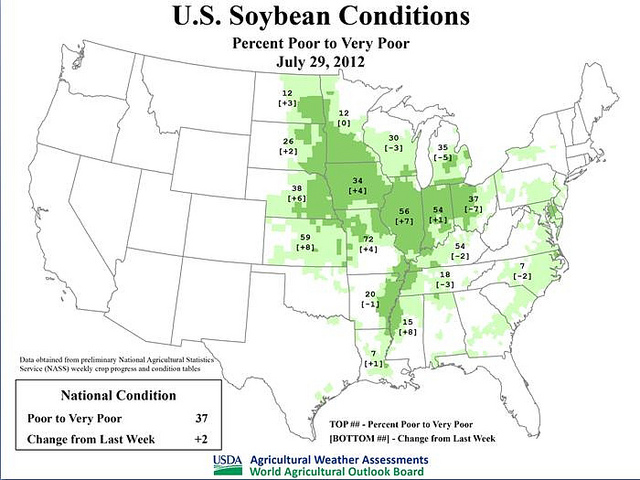
Not since the drought which hit the U.S. in 1988 has 37% of the nation’s soybean crop been rated at poor or very poor. Thirty-seven percent was the highest number for poor to very poor reached in July of 1988.

Filed Under: Blog Tagged With: Drought, Ohio, Soybeans

« Previous Page
Next Page »
  • Email
  • Facebook
  • RSS
  • YouTube

Latest News from the Ohio & National Farmers Union

OFU Rallies for Rural Schools

Fair School Funding Plan Integral for Rural Public Schools COLUMBUS – The League of Women Voters of Ohio and Ohio Farmers Union held a Statehouse … Read More

Public Schools Build Connections in Rural Communities. Vouchers Tear Them Down.

by Melissa Cropper, president, Ohio Federation of Teachers This op-ed was orignally published on Barn Raiser: Rural communities depend on … Read More

National Farmers Union Week of Action for Strong Farm Bill

National Farmers Union (NFU) today concluded the Week of Action that gathered more than 100 farmers from across the country to the halls of Congress … Read More

How Do Tariffs Affect Family Farms?

A Talk in Kent, Ohio with Ohio Farmers Union and Others Have you noticed the price of eggs? Who hasn’t! How do government actions and tariffs … Read More

Check Out the Entire Blog

NATIONAL FARMERS UNION

Click to Take Action


Contact

Ohio Farmers Union
P.O. Box 363
1011 N. Defiance Street
Ottawa, Ohio 45875
Phone: (419) 523-5300
Toll Free: (800) 321-3671

Copyright Ohio Farmers Union© 2025 | Site by: RCS Communications


Loading Comments...