At OFU’s recent summer picnic and full board meeting, I caught up with Executive Director Linda Borton and President Joe Logan to get a video update on how the organization is doing this year:
NFU still fighting for original Renewable Fuel Stand targets
from the National Farmers Union
National Farmers Union President Roger Johnson urged the Administration to act quickly on finalizing the Renewable Fuel Standard (RFS) rule and reiterated the importance of the RFS goals to family farmers and the rural economies they support.
“Biofuels are a critical component of this nation’s energy portfolio, decreasing our dependence on foreign oil imports while also giving a shot in the arm to family farms and the larger rural economies they support,” said Johnson.
The RFS is our nation’s main policy driver for renewable fuels, and since its creation by Congress has created $184.5 billion in economic impact while supporting 852,056 jobs nationwide. The biofuels industries – and the farmers who grow the grains they use – are poised for continued growth but need a clear signal that the targets will remain firm.
“The RFS has created a win-win-win scenario for the environment, farmers, jobs and consumers, and deserves the full support of the Administration,” he said.
Johnson said that the mixed messages coming from the U.S. Environmental Protection Agency (EPA) regarding the Administration’s support for the RFS targets, combined with the lengthy delays in finalizing the rule, have been a set-back to the biofuels industry and farmers who grow the grains they need. “These lengthy delays and the mixed messages from EPA have very seriously damaged all advanced biofuels, including the cellulosic ethanol biofuel industry,” said Johnson.
OFU Endorses ‘Move to Amend’
At its recent full board of directors meeting, the Ohio Farmers Union endorsed the organizaiton, Move to Amend.
The grassroots organization has a simple goal that will be a Herculean task: get the U.S. Constitution amended to explicitly state two things:
- Corporations are not people
- Money is not speech
Watch the video below featuring Prof. Steve Nelson of Miami University. Nelson is the SW Ohio organizer for Move to Amend and spoke to the OFU board at the annual summer picnic at the Ohio Caverns:
NFU Says Dept. of Justices Ignores Anti-Trust Laws in O.K. of Tyson-Hillshire Merger
 from the Naitonal Farmers Union:
National Farmers Union President Roger Johnson issued the following statement in response to the announcement that the Department of Justice has approved the Tyson-Hillshire merger:
“Anti-trust laws were put on the books to keep powerful industries – like the meat industry – from being overly consolidated. Yet nearly every merger request they file is approved by the Department of Justice. As a result, the meat industry grows more powerful by the day and the family farmer continues to get squeezed.
“This is because farmers are price takers not price makers, and when the number of buyers is decreased, the sales options left to farmers and ranchers are fewer and fewer and the ability of the buyers to dictate prices to producers continues to increase. The top four meat packers already control 80 percent of the market and now that number has just gone up.
“Once again, the Department of Justice has turned its back on family farmers.”
Margin Protection Program Replaces MILC – Enrollment Begins Sept. 2
USDA has announced that enrollment for the new dairy program – the Margin Protection Program – will begin on September 2.
MPP replaces Milk Income Loss Contracts.
The voluntary program, established by the 2014 Farm Bill, provides financial assistance to participating farmers when the margin – the difference between the price of milk and feed costs – falls below the coverage level selected by the farmer.
National Farmers Union President Roger Johnson commended USDA on their timely rollout of the dairy Margin Protection Program and for including provisions that will help America’s family farmers with their risk management needs.
“America’s family-run dairy farms are in great need for these kind of risk management tools to help them manage risk that is beyond their control,” said Johnson.
“The family farmer provision, included as part of the program, will allow many of this nation’s family-operated dairy farms to breathe a sigh of relief now that they have adequate risk management tools in hand. It is unfortunate that the Congress did not include a dairy stabilization program that would have helped take the volatility out of milk prices,” Johnson added.
USDA also announced the Dairy Product Donation Program (DPDP), which will donate dairy products to low-income people, including food banks, state and local agencies and advocacy organizations.
Dairy farmers should also be aware of an online tool USDA has created to help them determine their level of coverage under MPP. Follow this link to use the tool.
The Margin Protection Program, which replaces the Milk Income Loss Contract program, gives participating dairy producers the flexibility to select coverage levels best suited for their operation. Enrollment begins Sept. 2 and ends on Nov. 28, 2014, for 2014 and 2015. Participating farmers must remain in the program through 2018 and pay a minimum $100 administrative fee each year. Producers have the option of selecting a different coverage level during open enrollment each year.
Dairy operations enrolling in the new program must comply with conservation compliance provisions and cannot participate in the Livestock Gross Margin dairy insurance program. Farmers already participating in the Livestock Gross Margin program may register for the Margin Protection Program, but the new margin program will only begin once their Livestock Gross Margin coverage has ended.
Call or visit your local USDA Farm Services Agency office to learn more or to enroll in MPP. You can also view or download the USDA’s fact sheet on MPP here.
Two Notes from USDA on Conservation Reserve Program
 USDA has issued two recent notices on the Conservation Reserve Program.
The first is just a reminder for farmers or landowners selling acres enrolled in CRP. Essentially, if CRP acres are sold, the original CRP contract must be revised and signed by the new owner within 60 days. If the contract is terminated by the new owner, the original CRP participant will be on the hook to refund USDA some payments:
If the new landowner elects not to continue the CRP contract, the contract will be terminated. When a contract is terminated, refund of the following payments plus interest is required from the original CRP participant: all annual rental payments, all cost share payments, signup incentive payments, and practice incentive payments. Liquidated damages are also assessed.
Refunds of payments will not be required in cases where the owner’s estate or the heirs do not succeed to the contract. There are other cases that do not require the refund of payments, when a participant loses control of the land, such as eminent domain.
The other notice was that under the new Farm Bill early termination of some CRP contracts will be allowed. Early outs are available for the following contract types:
- CP1-establishment of permanent grasses
- CP2-establishment of permanent grasses
- CP3-tree planting
- CP10-grass cover already established
- CP11-tree cover already established
Here’s a link to a USDA fact sheet on early CRP contract terminations under the new Farm Bill
As always, you can receive more information by contacting your local USDA Farm Services Agency office.
USDA Update on 2014 Farm Bill Implementation
Outlined below is a list, by Farm Bill title, of the components of the recently enacted Farm Bill and the U.S. Dept. of Agriculture’s progress in implementing the new law. This was released by USDA on August 6, 22014.
TITLE I – Commodity Programs
- Agricultural Risk Coverage Program and Price Loss Coverage Program: On April 29, USDA began a competitive process to award funding for Farm Bill decision aids and outreach tools for the new Agricultural Risk Coverage Program and Price Loss Coverage Program. Awards totaling $6 million were announced in May 2014. On August 1, farmers and ranchers began receiving acreage history and yield updates to prepare them for later enrollment in these safety-net programs.
- Supplemental Agricultural Disaster Assistance: On April 14, USDA published a final rule to implement the disaster assistance provisions. Sign up for these programs began on April 15, 2014.
- As of July 31, 2014, approximately 238,000 applications have been received and $1.85 billion in payments have been disbursed through the Livestock Indemnity Program, Livestock Forage Disaster Program, and Tree Assistance Program.
- On July 31, USDA extended the deadline for the Emergency Assistance for Livestock, Honeybees, and Farm-Raised Fish Program to August 15, 2014.
- On July 22, USDA announced Noninsured Crop Disaster Assistance Program (NAP) assistance for losses to bush or tree fruit crops due to frost or freeze during the 2012 crop year.
- Beginning Farmers and Ranchers: On June 23, USDA announced new support for beginning farmers and ranchers, including waiving fees for certain disaster assistance programs, eliminating payment reductions under the Conservation Reserve Program (CRP), and increasing payment rates by 50 percent under Emergency Assistance for Livestock, Honeybees and Farm-Raised Fish Program (ELAP).
- Dairy Forward Pricing Program: On March 21, USDA re-established the Dairy Forward Pricing Program and on March 28, extended Milk Income Loss Contracts until September 1.
- Loan Rates: On June 24, USDA announced loan rates for 2014 Crop Peanuts. County and regional loan rates were announced in a press release on March 28, 2014.
- Extension of Programs: On March 28, the Farm Service Agency (FSA) published in the Federal Register notices for the extension of the following programs: (1) Marketing Assistance Loans; (2) Milk Income Loss Contract; (3) Dairy Indemnity Payment Program; (4) Non-Insured Crop Disaster Assistance Program; (5) Loan Deficiency Payments; and (6) Sugar.
CAUV Values to Skyrocket for 2014 Tax Year
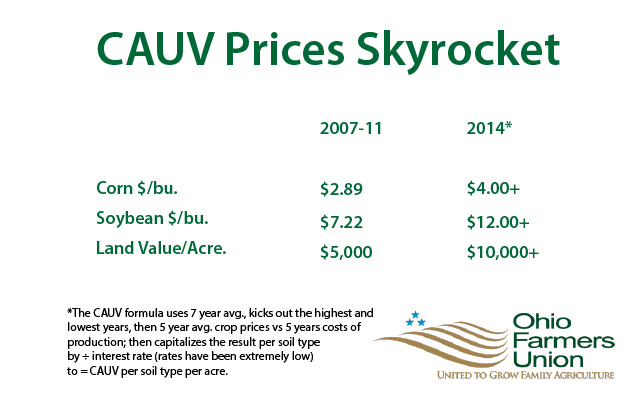 Farmers across Ohio have benefited in the past in regards to CAUV values that have been kept extremely low and now these values are scheduled to increase quite a bit in the next few years.
Ted Finnarn, Darke County attorney, is the Ohio Farmers Union representative to the Agricultural Advisory Committee of the Division of Tax Equalization and this CAUV Advisory Committee functions to advise the Ohio Department of Taxation on the operation of the Current Agricultural Use Valuation (CAUV) law and the consequent valuations used under the law.
Finnarn has served on this State Committee for over 38 years originally being appointed by the Ohio Farmers Union in 1976. Scott Zumbrink, Darke County Treasurer, has also served on the committee, representing the State Treasurers’ Association since 2007.
According to Finnarn and Zumbrink, the CAUV table valuations (which vary according to soil type, slope, drainage and soil management groups, using inputs of a 5-year “olympic” average of crop prices and costs of production) will increase substantially for tax year 2014 effective for taxes to be paid in 2015. When the more important comparison is made between the 2011 table valuations to the 2014 valuations (the 2011 table being the last one used by counties, which will now use the 2014 values, due to the 3 year rotation), farmers may see increases of approximately 110-185% or more in CAUV values.
Job Posting: NFU in Washington, D.C. Looking for Govt. Relations Representative
If you know someone with a background in agriculture, politics and a keen interest in advocating on behalf of family farmers, ranchers and fishers around the country – and they would be interested in working for the National Farmers Union – have them take a look at the link below:
A few words on Toledo water crisis
Well, when roughly half a million people in and around Ohio’s fourth largest city can’t shower, wash clothes and dishes or drink their tap water for two days, the politicians start to pay attention to the annual environmental catastrophe known as the Lake Erie algal bloom.
If you’ve followed the Ohio Farmers Union’s take on water quality and agriculture’s role, you’ll know that OFU acknowledges the science that places agriculture at the top of the list of contributors of nutrients into Lake Erie and other surface waters and we are committed to having agriculture be a major part of the solution.
In reviewing the State’s response to our water quality problems, we believe there is one segment of nutrient management that has been ignored by the decision-makers in Columbus. That’s the use of manure from large animal feeding operations. Ohio is home to many thousands of these industrial scale livestock facilities. Only the 200 largest of which are managed under oversight of the Ohio Department of Agriculture (ODA). Manure from confined animal feeding operations supplies a significant proportion of the nutrients that Ohio farmers use to boost crop production.