Ohio Farmers Union

Serving Family Farmers and Consumers Since 1934


United to Grow Family Agriculture Since 1934

  • About
    • The Farmers Union Triangle
    • Vision
    • OFU Leadership
  • Issues
    • 2020 Virtual Lobby Days
    • OFU Policy & NFU Policy
    • 2019 Lobby Day Registration
    • Get Involved!
    • NFU Climate Leaders
  • Education
    • 2019 OFU Essay Contest
    • Ohio Farmers Union Scholarships
    • Farm Safety
    • Renewable Energy Curriculum
  • Insurance
    • Hastings Mutual Insurance Co.
    • Health & Other Offerings
    • Ohio BWC Group Coverage
  • Join Us
    • Member Benefits
    • Insurance
  • Blog

PED Pig Virus Persists, Origin Still Unknown

June 6, 2014 By Ron Sylvester Leave a Comment

If you raise hogs, you’re undoubtedly aware of a nasty virus attacking swine on farms across the country called Porcine Epidemic Diarrhea virus or PEDv.

You might not know that it was first spotted in the U.S. in Ohio in 2013. While Ohio is not currently the state with the most documented cases of PEDv, our state is at the geographic heart of the disease. According to data being collected by USDA’s Animal and Plant Health Inspection Service, the midwestern U.S. states are the epicenter of PEDv. According to various media reports, U.S. officials are not certain as to how PEDv – more common in other parts of the world – got into the U.S.

On Wednesday, USDA Secretary Tom Vilsack announced $26 million is being pushed at various responses to PEDv. In a news release, USDA pointed out that the virus is not harmful to humans and poses no risk to food safety.

PEDv has had serious effects on many U.S. farms, though.

“In the last year, industry has estimated PEDv has killed some 7 million piglets and caused tremendous hardship for many American pork producers,” said Vilsack.

“The number of market-ready hogs this summer could fall by more than 10 percent relative to 2013 because of PEDv. Together with industry and our State partners, the steps we will take through the Federal Order will strengthen the response to PEDv and these other viruses and help us lessen the impact to producers, which ultimately benefit the consumers who have seen store pork prices rise by almost 10 percent in the past year.”

A USDA federal order requires producers, veterinarians, and diagnostic laboratories to report all cases of PEDv and other new swine enteric coronavirus diseases to USDA and state animal health officials. The industry is already seeing herds previously impacted by the virus become re-infected, and routine and standard disease reporting will help identify the magnitude of the disease in the United States and can help determine whether additional actions are needed.

Here are a few links to file away to continue to follow news on PEDv and the efforts to combat the virus:
  • USDA APHIS Page on PEDv and Swine Enteric Coronavirus Diseases
  • Questions and Answers on PEDv by USDA
  • Link to archive of weekly updates from APHIS on PEDv

Filed Under: Blog Tagged With: PEDv, Pig Virus

OFU President Joe Logan’s Letter to Gov. Kasich Asking for Veto on SB 310

May 30, 2014 By Ron Sylvester Leave a Comment

Ohio Farmers Union President Joe Logan today released a letter he has emailed and posted to Gov. John Kasich regarding S.B. 310 which would freeze Ohio’s renewable energy and energy efficiency mandates.

Read the Letter

Learn More About This Issue

Filed Under: Blog Tagged With: Energy Efficiency, Joe Logan, John Kasich, Mandates, Renewable Energy, SB 310

Ask Gov. Kasich to Veto S.B. 310 and Preserve Ohio’s Renewable Energy Mandate

May 30, 2014 By Ron Sylvester 1 Comment

The Ohio Farmers Union has passed a “Special Order of Business” in at least the last three conventions calling on Ohio’s elected leaders in Columbus to preserve landmark, bipartisan legislation passed in 2008 which established energy efficiency and renewable energy mandates for Ohio’s public electrical utilities. Known as “25 by 2025” the 2008 law put utilities on a path toward ensuring that at least 25% of the power they sell in Ohio comes from renewable energy resources.

Despite the fact that the the evidence shows job creation, a reduction in air pollution and even an increase in Payments in Lieu of Taxes in areas where renewable energy projects are creating new businesses and jobs, a minority of well-connected Ohio business and political interests have sought to roll back the mandates on primarily ideological and narrow economic ground.

Here are just a few facts that came out over the course of testimony on S.B. 310:

  • Ohio’s four major utilities have spent $456 million on energy efficiency programs – but saved themselves and ratepayers just over $1 billion from 2009 through 2012.
    • AEP Spent: $158 million; Saved: $377 million
    • Dayton Power & Light Spent: $49 million; Saved: $154 million
    • Duke Spent: $90 million; Saved: $197 million
    • FirstEnergy Spent: $159 million; Saved: $317 million
  • The numbers above come from the utilities themselves!
  • Ohio’s air has been cleaner due to the renewable energy and energy efficiency mandates:
    • Annually, over 9,000 tons of the smog-forming pollutant Nitrogen Oxide has been removed from our air
    • Annually, over 40,000 tons of Sulfur Dioxide – a pollutant linked to asthma and other respiratory problems – has been removed from our air
    • Annually, 1,000 tons of mercury is prevented from entering our air due to the mandates

Call Governor Kasich office today at (614) 466-3555. Give the receptionist your name and hometown and tell them you’re calling to urge the governor to VETO S.B. 310. Tell them you’re concerned about going backwards on air pollution and creating a more diversified energy economy. If you are involved in the renewable energy economy either on your own farm or in an off-farm career, let them know.

The governor is expected to sign S.B. 310, but I can tell you from experience working for members of Congress and former Gov. Strickland that these calls matter. Sometimes they even change minds.

Finally, send this email to your non-OFU friends and contacts. This bill really is a step backward for Ohio and serves only the interests of a very (politically connected) few.

Filed Under: Action Alerts, Blog Tagged With: AEP, Dayton Power & Light, Duke, Energy Efficiency, FirstEnergy, John Kasich, Mandates, Renewable Energy, SB 310

Congresswoman Kaptur Provides Great Farm Bill Info

May 22, 2014 By Ron Sylvester Leave a Comment

Always a friend to family farmers and the Ohio Farmers Union, Congresswoman Marcy Kaptur has put together a great fact sheet on the 2014 Farm Bill and what it might mean for you and your farm. Right at the top she even provides two contacts in her office – both in D.C. and the district – who are prepared to help answer your Farm Bill questions.

Filed Under: Blog Tagged With: Marcy Kaptur

USDA to Host Google Hangout for New Farmers Regarding 2014 Farm Bill Opportunities

May 22, 2014 By Ron Sylvester Leave a Comment

If you are a new or beginning farmer you might be interested in an opportunity to participate in a Google+ Hangout with USDA Deputy Secretary Krysta Harden on May 28.

Harden will discuss features of the recently enacted 2014 Farm Bill that specifically target new farmers and ranchers. According to a blog post at USDA, Harden will also address helping new farmers and ranchers determine who may be their best point of contact for using Farm Bill programs.

To participate in the Hangout check out www.usda.gov/live at 3 p.m. on the 28th. Alternatively, you can also access the Hangout from the USDA Google+ page.

Filed Under: Blog

Time Running Out to “vote” on National Soybean Checkoff

May 16, 2014 By Ron Sylvester Leave a Comment

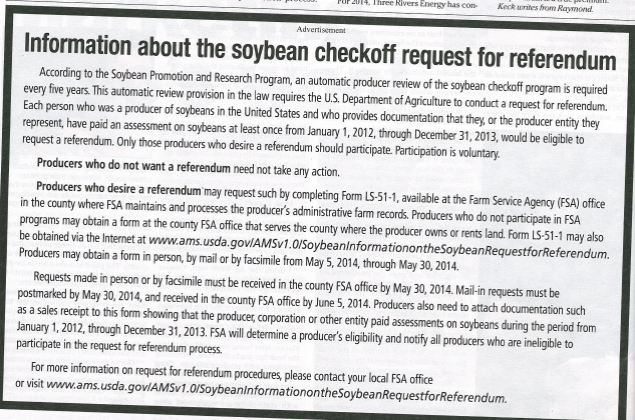
image005Soybean farmers have until the end of this month, May 30, 2014, to contact their local FSA office to essentially vote in favor of USDA holding a national referendum on the future of the Soybean Promotion and Research Program (the Soybean Checkoff).


Under the rules of the national soybean checkoff program, every five years the USDA must give farmers the opportunity to vote to continue the program. Rather than simply hold a vote where farmers could register a “yes” or “no” on the program, USDA first conducts a “request for referendum” – which is what is happening now.

What this boils down to is this:

If you are entirely happy with the soybean checkoff, do nothing. Doing nothing essentially means you don’t wish to have a vote.
If you would like the opportunity to vote on the continuation of the program, you should participate in this request for referendum by May 30.

To participate, contact your local FSA office and request information on the soybean checkoff referendum procedures. You may also find information online at www.ams.usda.gov.

You are eligible to participate if you, as the producer, corporation or other entity paid checkoff assessments on soybeans between January 1, 2012 through December 31, 2013. You will also need to one piece of documentation, such as a sales receipt,  to the form you will fill out as proof.

If you wish to go online and sort this out for yourself, USDA doesn’t make it simple. The agency’s descriptions of what’s going in news releases and elsewhere are “govspeak,” there is at least one critical broken link on a page to information and the latest press release didn’t even include direct links or concise, clear instructions on how to participate. So, here are a couple of links if you don’t want to handle matters in-person at your FSA office:

  1. Latest news release
  2. Information on Soybean Request for Referendum page
  3. Soybean Request for Referendum form – there are no instructions here, this is why going to your local office may be the best bet with limited time until the deadline. Just be sure to take a piece of documentation as described earlier in this post.
  4. USDA FAQ on the Request for Referendum

Ohio Farmers Union policy is that all checkoff programs should be voluntary at the point of sale. This means that rather than your local elevator collecting the 1/2 cent per bushel on your beans automatically, you should be asked whether you wish to participate.

With the recent passage of an increased Ohio Beef Checkoff and this request for a referendum on the soybean checkoff, several OFU members have spoken up at recent county meetings and contacted our state office requesting guidance on getting checkoff dollars refunded. Please watch the Ohio Farmers Union website and the next edition of the Ohio Country Messenger for an explainer on checkoff refunds for farmers.

Filed Under: Blog Tagged With: Request for Referendum, Soybean Checkoff, Soybean Promotion and Research Program

Two New USDA Conservation Programs are Open for Application by Farmers

May 5, 2014 By Ron Sylvester Leave a Comment

The 2014 Farm Bill has yielded two new conservation programs at USDA which have opened their application processes to begin spending up to $368 million across the country to restore wetlands, support outdoor recreation opportunities and boost rural economies.

The new programs are Agricultural Conservation Easements Program (ACEP) and the Voluntary Public Access and Habitat Incentive Program (VPA-HIP).

ACEP is the consolidation of three former programs – the Farm and Ranch Land Protection Program, the Grassland Reserve Program and the Wetlands Reserve Program—into one to make conservation efforts more efficient while strengthening tools to protect land and water according to a USDA release.

ACEP contains two primary components. The first, agricultural lands, provides funds to those eligible for the purchase of agricultural land easements that protect the agricultural use and conservation value of eligible land.

Both ACEP programs have application for funding deadlines in early June 2014. Please check with your regional or county Farm Services Agency office for complete information.

The second is the wetland reserve component which provides landowners funds to purchase an easement and for restoration of wetlands and improving habitat for migratory birds and other wildlife. USDA said that lands that are eligible for a wetland reserve easement include farmed or converted wetlands that can be successfully and cost-effectively restored.

VPA-HIP is a competitive grant program that enables state and tribal governments to increase opportunities for landowners of private lands to make their land available for public recreation.

Landowners may learn more from their regional or county Farm Services Agency or by visiting the Natural Resources Conservation Service online.


Filed Under: Blog Tagged With: 2014 Farm Bill, ACEP, Conservation Programs, USDA, VPA-HIP

Final Data in 2012 U.S. Ag Census – Lots to Consider

May 2, 2014 By Ron Sylvester Leave a Comment

agcensuspostEarlier today USDA held an online event to unveil updated and final data from the agency’s census of U.S. agriculture concluded in 2012. From USDA, here are some takeaways from the updated numbers:

  • 22% of all farmers were beginning farmers in 2012. That means 1 out of every 5 farmers operated a farm for less than 10 years.
  • Young, beginning principal operators who reported their primary occupation as farming increased from 36,396 to 40,499 between 2007 and 2012. That’s an 11.3% increase in the number of young people getting into agriculture as a full-time job.
  • 969,672 farm operators were female—30% of all farm operators in the U.S.
  • The number of farms ran by Latino farmers increased from 82,462 in 2007 to 99,734 in 2012. That 21% increase reflects the changing face of America as a whole.
  • 70% of all farms in the U.S. had internet access in 2012, up from 56.5% in 2007, but there is more work to be done to expand internet access in rural America.
  • Farmers and ranchers continue to lead the charge towards a more sustainable energy future. 57,299 farms reported using a renewable energy producing system in 2012. That’s more than double the 23,451 operations that reported the same in 2007. Solar panels accounted for 63% of renewable energy producing systems on farms, with 36,331 farms reporting their use.
  • Nearly 150,000 farmers and ranchers nationwide are selling their products directly to consumers, and 50,000 are selling to local retailers. Industry estimates valued local food sales at $7 billion in 2011, reflecting the growing importance of this new market to farm and ranch businesses.
  • Total organic product sales by farms have increased by 82% since 2007, from $1.76 billion in 2007 to $3.1 billion in 2012. Organic products were a $35 billion industry in the United States in 2013.

If you want pore over the full report with lots of tables and charts covering everything from hogs to Christmas trees, click here.

If you want to explore USDA’s other Ag Census related docs, including issue specific info and tools for getting the data you want, check out their Ag Census page.

Filed Under: Blog Tagged With: Ag Census, USDA

NFU: COOL, GIPSA Will Come Under Fire in Appropriations Process

May 1, 2014 By Ron Sylvester Leave a Comment

While the appropriations that routinely wind their way through Congress aren’t supposed to create – or kill – policies already passed in other bills, the National Farmers Union is warning that opponents of Country of Origin Labeling and the Grain Inspection Packers and Stockyards Administration will try to harm both COOL and GIPSA by starving them of funding.

NFU President Roger Johnson testified before the US House Agriculture Subcommittee on Livestock, Rural Development and Credit. Members of the committee heard from several interested parties on the state of the U.S. livestock industry earlier this week.

Johnson reminded the committee that rural America has lost 34 percent of beef operations and 91 percent of hog farms since 1980 – a total loss of 1.1 million livestock farms. There are also fewer meatpackers and processors. Today, the top four beef packers have control over 81 percent of cattle slaughter in the U.S.,
and the top four swine processors control 65 percent of hog sales.

In meetings sponsored by the Ohio Farmers Union earlier this year, farmers, FSA and state extension officials all seemed to agree that one constraint in promoting a grass-fed beef cooperative in northwestern Ohio is the dearth of independent processing in Ohio. Speakers representing their own successful independent family farm livestock operations and cooperatives told OFU members that attempting to work with the multi-national, market-dominating processors will only lead to total dependence and the potential for ruin if a farmer runs afoul of the system and is essentially black-balled in the Big Ag marketplace.

“Fewer livestock buyers result in less competition, greater opportunity for antitrust violations, and a difficult market for the remaining farmers and ranchers,” said Johnson. “The U.S. Department of Agriculture has the authority to prohibit deceptive or fraudulent buying practices by processors and may protect farmers and ranchers if they have been harmed by unfair trade practices, but appropriations riders over the last three years have kept USDA from implementing these basic fairness rules. Future riders that impede enforcement of the Packers and Stockyards Act must be defeated,” Johnson said.

On COOL, Johnson told the committee, “I commend Congress for maintaining (COOL) standards in the 2014 Farm Bill. Consumers want to know more about the food they purchase, while U.S. farmers and ranchers are proud of what they produce.”

“NFU strongly opposes the use of an appropriations rider or other legislative vehicle to deny consumers access to information about their food.”

Read NFU’s Entire Testimony – Lots of Great Info


Filed Under: Blog Tagged With: Appropriations, Big Ag, Congress, COOL, GIPSA, U.S. Livestock

New OSHA Fact Sheet on Farm Safety

April 20, 2014 By Ron Sylvester Leave a Comment

According to the National Safety Council, agriculture is still the most dangerous work environment in the U.S. Take a few minutes and review this latest Occupational Safety and Health Administration fact sheet on farm safety. If you own a farm where you employ others or where your kids are working when they’re not in school, check out some of the Ohio Farmers Union fact sheets on specific farm safety hazards like grain bins and electrical shock hazards. These materials are great for teaching and training.

Filed Under: Blog Tagged With: Farm Safety, OSHA, Safety

« Previous Page
Next Page »
  • Email
  • Facebook
  • RSS
  • YouTube

Latest News from the Ohio & National Farmers Union

OFU Rallies for Rural Schools

Fair School Funding Plan Integral for Rural Public Schools COLUMBUS – The League of Women Voters of Ohio and Ohio Farmers Union held a Statehouse … Read More

Public Schools Build Connections in Rural Communities. Vouchers Tear Them Down.

by Melissa Cropper, president, Ohio Federation of Teachers This op-ed was orignally published on Barn Raiser: Rural communities depend on … Read More

National Farmers Union Week of Action for Strong Farm Bill

National Farmers Union (NFU) today concluded the Week of Action that gathered more than 100 farmers from across the country to the halls of Congress … Read More

How Do Tariffs Affect Family Farms?

A Talk in Kent, Ohio with Ohio Farmers Union and Others Have you noticed the price of eggs? Who hasn’t! How do government actions and tariffs … Read More

Check Out the Entire Blog

NATIONAL FARMERS UNION

Click to Take Action


Contact

Ohio Farmers Union
P.O. Box 363
1011 N. Defiance Street
Ottawa, Ohio 45875
Phone: (419) 523-5300
Toll Free: (800) 321-3671

Copyright Ohio Farmers Union© 2025 | Site by: RCS Communications


Loading Comments...