We are into another season where OFU young adults are competing for college scholarships. The competition is an essay contest once again. Head over to the OFU Scholarships Page for more information and applications!
2012 Crop Year Commodity Loans Available
USDA FSA has this reminder for producers:
Now that the 2012 harvest is nearly complete, the Farm Service Agency reminds producers of their options to obtain a Marketing Assistance Loan for 2012 crop corn and soybeans. For the 2012 crop year, the corn and soybean loan rates are $1.91 and $5.09 per bushel. The Market Assistance Loan program provides producers with cash flow at a reasonable interest rate while the crop is in storage on the farm or at a local elevator. The November 2012 interest rate is 1.125%.
You can read the entire release here, or for information contact your local FSA office or visit the FSA website.
Farm Income Estimate Shows Many Farmers Still Working Off-Farm Too
USDA today released the latest 2012 Farm Income Forecast and data show many family farmers are still dependent on off-farm income to make ends meet.
Overall, economic numbers for agriculture look good despite the drought that plagued much of the country this year. USDA Secretary Tom Vilsack said in a press release:
“Today’s forecast is heartening. It confirms that American farmers and ranchers remained impressively resilient in 2012, even with tough odds due to one of the worst droughts in more than a generation. Thanks to its ability to remain competitive through thick and thin, U.S. agriculture is stronger today than at any time in our nation’s history, supporting and creating good-paying American jobs for millions. While down slightly from the August forecast, today’s estimates for net farm income are the second-highest since the 1970s, while total farm household income is expected to rise. At the same time, the positive trend of falling debt ratios continue. The forecast suggests that strong farm income should remain a positive factor in carrying farmers and ranchers into the 2013 growing season.”
Here are two charts that caught my eye from the report.
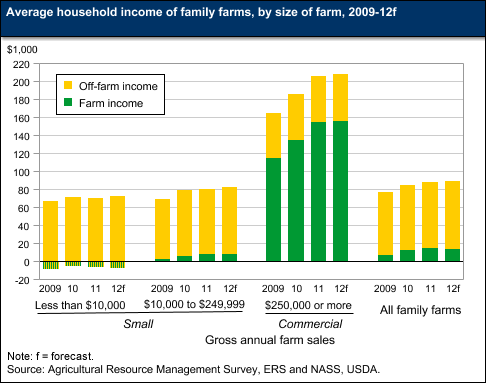
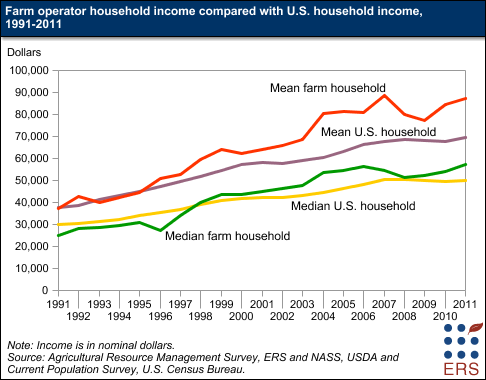
First, size matters in today’s agricultural economy. The chart below shows that if your farm is generating less than $250,000 in gross sales, a large portion of your household income is probably coming from off-farm work or another source. The second chart below shows that farm households do a bit bitter in terms of median and mean income as compared with all households.
 If you want to take a look at more on this topic, visit the Farm Sector Income & Finance pages at USDA ERS.
U.S. EPA keeps renewable fuel standard in place
Some states had requested loosening in wake of drought
You may recall that during the height of the summer drought season, some states had requested that the U.S. Environmental Protection Agency temporarily loosen the renewable fuel standard affecting gasoline. States argued that looser standards would help alleviate expected price pressure on corn due to the drought. Here’s what the EPA said in a press release today:
The U.S. Environmental Protection Agency (EPA) today announced that the agency has not found evidence to support a finding of severe “economic harm” that would warrant granting a waiver of the Renewable Fuels Standard (RFS). The decision is based on economic analyses and modeling done in conjunction with the U.S. Department of Agriculture (USDA) and U.S. Department of Energy (DOE).
“We recognize that this year’s drought has created hardship in some sectors of the economy, particularly for livestock producers,” said Gina McCarthy, assistant administrator for EPA’s Office of Air and Radiation. “But our extensive analysis makes clear that Congressional requirements for a waiver have not been met and that waiving the RFS will have little, if any, impact.”
To support the waiver decision, EPA conducted several economic analyses. Economic analyses of impacts in the agricultural sector, conducted with USDA, showed that on average waiving the mandate would only reduce corn prices by approximately one percent. Economic analyses of impacts in the energy sector, conducted with DOE, showed that waiving the mandate would not impact household energy costs.
EPA found that the evidence and information failed to support a determination that implementation of the RFS mandate during the 2012-2013 time period would severely harm the economy of a State, a region, or the United States, the standard established by Congress in the Energy Policy Act of 2005 (EPAct).
EPAct required EPA to implement a renewable fuels standard to ensure that transportation fuel sold in the United States contains a minimum volume of renewable fuel. A waiver of the mandate requires EPA, working with USDA and DOE, to make a finding of “severe economic harm” from the RFS mandate itself.
Sign petition asking Congress to finish Farm Bill
 Our friends at the Ohio Ecological Food & Farm Association are circulating an online petition aimed at getting Congress to finish the Farm Bill during the lame duck session. We’re asking you to follow the link that comes after the petition text below and sign on. I just did it and it took 30 seconds. Roger Wise and Linda and Mel Borton signed as well. You do not have to leave your phone number or street address, but your name, email address, city and zip code are appreciated and lets our representatives in Washington know there are real people behind this campaign.
As you all know, the Senate passed a Farm Bill earlier this year that contained real deficit reduction and moves farm support programs away from direct payments and into a crop insurance program. The House Ag committee followed suit, but House Speaker John Boehner has held up moving it to the floor for a vote because of opposition by some on the GOP side of the aisle. If you read the blog, you know that there are programs like MILC – which helps small dairy farmers – that are expired. Also expired is the non-insured crop disaster assistance program, or NAP. We need the Farm Bill to get to the floor for a vote, where it’s hoped a bipartisan coalition can be put together as it was in the Senate.
The OEFFA petition reads:
Dear Congress,
For the sake of our nation’s health, our farmers, and our natural resources, we need you to do your job. We need a better Farm Bill, and we need it this year!
An equitable, sustainable, 21st century Farm Bill must:
– INVEST IN THE FUTURE OF HEALTHY FARMS, FOOD, and PEOPLE
– PROTECT OUR PRECIOUS AIR, SOIL, and WATER
– REFORM FARM SUBSIDIES and LEVEL THE PLAYING FIELD
Signed,
Please Click Here to Go to the OEFFA Site to Sign the Petition before November 14
Deadline approaches for non-insured crop disaster assistance program (NAP)
USDA’s Farm Service Agency wants farmers to know that November 20 is the deadline for the NAP program.
The Noninsured Crop Disaster Assistance Program (NAP) provides financial assistance to producers of non-insurable crops when low yields, loss of inventory or prevented planting occur due to a natural disaster. USDA defines non-insurable crops as commercially produced agricultural commodity crops for which the catastrophic risk protection level of crop insurance is not available. NAP eligible crop examples:
- Pumpkins
- Sweet Corn
- Hay
- Nursery Crops
- Other vegetable crops
Eligible producers must apply for coverage of non-insurable crops using Form CCC-471, “Application for Coverage,” and pay the applicable service fee at the FSA office where their farm records are maintained. The application and service fee must be filed by the application closing date as established by the FSA State Committee. The service fee is the lesser of $250 per crop or $750 per producer per administrative county.
Producers must apply by November 20, 2012. For information contact your local FSA office or call 440-437-6330.
NFU’s Johnson: Congrats for Obama, Beats Drum for Farm Bill By End of 2012
National Farmers Union President Roger Johnson issued the following statement in reaction to the results of the 2012 presidential election:
“On behalf of NFU’s membership, I congratulate President Obama on his re-election. He has shown his dedication to rural America over the past four years, and we will continue to work with him and the administration to ensure that continues.
“We will also continue to press Congress to pass a new five-year farm bill to be signed into law before the end of the legislative session on Dec. 31, 2012.”
Darke County Farmers Union Salute to Farmers Meeting a Success
from Ted Finnarn:

Pictured above, l-r seated, Blake Brandenburg, Swine; Maggie Weiss, Sheep; Ethan Fischer, Sheep; Miranda Bridenbaugh, Swine. Standing l-r, Scott Zumbrink, Darke County Treasurer; Carley Ingram, Candidate for Court of Appeals; Dave Shindollar, OFU Ins. Rep; Duane Shields, President of local Darke Farmers Union; Catey Fischer, Sheep; Thomas Schmitz, Sheep; and Alex Weiss, Champion Milking Shorthorn.
Darke County Farmers Union recently held their Fall Harvest-Salute to Farmers meeting on October 27 at the County Extension Office in Greenville. Over 40 turned out to honor the 4-H Youth that the Farmers Union supported at the recent Darke County Fair by either purchasing their livestock or by sponsoring their trophy.
Members also heard from several candidates and State Issues 1 and 2 were discussed. Farmers Union is supporting a “Yes” vote on State Issue 2.
Featured speaker for the evening was Dave Shindollar, insurance rep from the OFU State Office who discussed health, nursing home insurance, Part D Medicare drugs, and estate planning. A representative from US Sen. Sherrod Brown’s office also spoke at the meeting.
USDA Disaster Assistance – Something else that doesn’t exist without a Farm Bill
Part of what I do in creating content for this blog is use information that comes to me from the USDA in the form of press releases and other notices. I read through all of it and some of it shows up here. Sometimes I add or delete information to make it more Ohio-centric. A recent release came out regarding Hurricane Sandy. The gist was that USDA Secretary Tom Vilsack was reminding farmers and foresters about all that they should document after a severe weather event or other property-damaging disaster. Then, there was this at the end:
Agriculture Secretary Vilsack also reminds producers that the department’s authority to operate the five disaster assistance programs authorized by the 2008 Farm Bill expired on Sept. 30, 2011. This includes SURE; the Livestock Indemnity Program (LIP); the Emergency Assistance for Livestock, Honey Bees, and Farm-Raised Fish (ELAP); the Livestock Forage Disaster Program (LFP); and the Tree Assistance Program (TAP). Production losses due to disasters occurring after Sept. 30, 2011, are not eligible for disaster program coverage.
Yet another reminder of how Congress has left farmers, ranchers, fishers and foresters in the lurch without a Farm Bill. Secretary Vilsack goes on to promise to keep the pressure on the crop insurance industry to provide more flexibility for producers. That’s commendable, but there’s only so much the Secretary of Agriculture can do without all of his legal authority at hand. He would have that authority if Congress were to finish the job after the election.
OSU Extension – USDA host Licking County Meeting – Make Your Land Work for You
The Ohio State University Extension and the U. S. Department of Agriculture will host a public meeting November 8 at 6pm. The meeting will be held at the Licking County USDA Service Center located at 771 East Main St., Newark, Ohio 43055 to discuss local conservation and agriculture topics.
The discussion will begin with, “What is algae and why is there so much of it?” As OSU Extension experts explain what’s happening with algae in our lakes and what that means for farmers and other citizens.
“Why better soil grows better crops, and better pastures grow more nutritious food for grazing animals” as USDA Natural Resources Conservation Service (NRCS) District Conservationist explains how to make your land more productive.
Learn how USDA supports agriculture through conservation efforts and disaster relief as the NRCS State Conservationist and the Farm Service Agency (FSA) State Executive Director provide agency updates.
For more information about this meeting, please contact Christina Reed at 614-255-2527 or by email at Christina.Reed@oh.usda.gov