The National Farmers Union has three employment opportunities listed right now, including a government relations representative in Washington, D.C. Check out their employment page here.
Serving Family Farmers and Consumers Since 1934
The National Farmers Union has three employment opportunities listed right now, including a government relations representative in Washington, D.C. Check out their employment page here.
This post was written by Tom Driscoll of the National Farmers Union and is a part of the Climate Leaders project of NFU. Learn More.
For farmers, rain is generally a good thing. Crops don’t grow without water, and other NFU Climate Column posts discuss the problems farmers do and will encounter getting enough rain and water as climate change progresses. But farmers also know that too much rain all at once, or at the wrong time, can be just as harmful as too little rain.
USDA’s Northeast and Northern Forests Regional Climate Hub Assessment of Climate Change Vulnerability and Adaptation and Mitigation Strategies explains, “Projected increases in heavy precipitation combined with milder winters is expected to increase total runoff and peak stream flow during the winter and spring, which may increase the magnitude or frequency of flooding. Increases in runoff following heavy precipitation will also likely lead to an increase in soil erosion.” So far, the Northeast has experienced a greater increase in extreme precipitation events than other areas, but these harmful downpours are happening more frequently in many regions.
Increased extreme precipitation can disrupt the marketing infrastructure farmers rely on by complicating barge traffic on our rivers. It can affect yields by interfering with planting. Erosion and runoff are also costly; heavy rains may prevent crops from properly utilizing fertilizer, and concentrated nutrients in runoff can stress ecosystems, communities, and invite litigation and regulation.
Increased extreme precipitation events can have serious impacts on your operation, but acting now to fight climate change will help prevent worst-case scenarios for you and the generations that follow on your land. There is a lot that farmers can do to adapt to these changes, too. To learn how you can help avoid the most alarming climate change consequences and cope with the variations that cannot be avoided, stay posted with NFU’s Climate Column and check out the USDA Vulnerability Assessment covering your area.
This post originally appeared on the National Farmers Union blog and was written by Zack Clark, NFU Govt. Relations Representative.
 Last week, two major reports were released that further cemented what we already know – oversupply in the marketplace is driving commodity prices further and further downward, and after three years of declining prices, real estate values and credit conditions are beginning to deteriorate.
The glut of commodities highlighted by last week’s World Agricultural Supply and Demand Estimates Report (WASDE), which forecasted another increase in corn, soy, wheat, sorghum, barley, and oats, has the potential to continue prolonged periods of depressed prices. Continued overproduction has been failing to match actual demand, driving up supplies and straining storage capacity. Across the countryside, grain is being stored on the ground.
Equally alarming is the release of the Federal Reserve Bank of Kansas City’s second quarter assessment of agricultural credit conditions. Soon after the release of the bank’s first quarter report, NFU President Roger Johnson testified to Congress about the deteriorating credit conditions. As the second quarter report highlights, the situation continues to decline. It found that farm income has continued to fall, there is increased demand for loan renewals and short-term operating loans, and there are declines in repayment rates and falling farmland values.
Over the past year, National Farmers Union (NFU) has ramped up efforts to highlight the declines in the countryside to members of Congress in Washington, D.C. NFU has also long advocated for a strong safety net that reacts to the exact situation we find ourselves in today. Members of Congress, who are currently back home for the August congressional recess, need to hear about these problems from their constituents.
Congress will only be in session for four weeks between now and the election. Yet during September, while they are in Washington, they will need to pass legislation to fund the government. Farmers Union members need to let their congressional delegations know that these spending packages need to contain assistance to combat the deteriorating agricultural economy. Congress should:
~ Increase funding for the USDA’s farm loan programs,
~ Provide emergency assistance for producers in need, and
~ Work with the USDA to provide short-term remedies for low commodity prices.
In addition, Congress needs to immediately begin working on the next Farm Bill to provide a stronger safety net that protects family farmers and ranchers from very low prices. This safety net needs to be written to focus on the needs of our nation’s producers during tough times, not written to fit a certain price tag.
The NFU annual legislative fly-in will provide opportunities for NFU members to come to the nation’s capital to press members of Congress on these important issues and advocate on behalf of the nation’s family farmers and ranchers. A heavy focus of our members’ meetings with their representatives will be the depressed farm economy, and there are concrete asks that NFU is putting forward to help aid family farmers and ranchers through these tough times. We must not miss any opportunities to highlight the growing crisis in the rural economy to members of Congress, especially when its going on in their backyard.
from Ohio Dept. of Agriculture
The Ohio Department of Agriculture will be sponsoring a collection for farmers wishing to dispose of unwanted pesticides on Aug. 22 from 9:00 a.m. to 3:00 p.m. at the Hardin County Fairgrounds, 14134 County Road 140, Kenton, OH 43326.
The pesticide collection and disposal service is free of charge, but only farm chemicals will be accepted. Paint, antifreeze, solvents, and household or non-farm pesticides will not be accepted.
Pesticide collections are sponsored by the department in conjunction with the U.S. Environmental Protection Agency. To pre-register, or for more information, contact the Ohio Department of Agriculture at 614-728-6987.
Source: Congressional Research Service
The National Farmers Union Board of Directors passed two policy resolutions in July regarding the worsening farm economy and continuing consolidation in the crop inputs and agriculture chemicals industries.
Ohio Farmers Union President Joe Logan, an NFU board member, attended the meeting in Healdsburg, California and voted in favor of both resolutions.
“As a farmer-led organization, we proudly advocate for the issues important to our nearly 200,000 family farm and ranch members. The farm economy and consolidation in agriculture are two timely industry topics, and these board-passed resolutions will define precise calls to action for our organization,” said NFU President Roger Johnson.
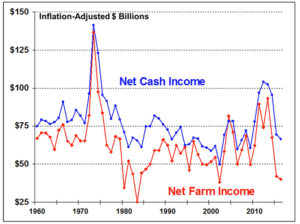
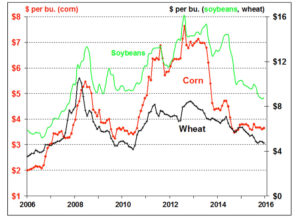
NFU has been a vocal advocate in support of a strong safety net to aid farmers as they continue to face low commodity prices and high input costs. The farm economy resolution calls for “corrective action and evaluation of price support levels” so that farm programs can serve to minimize the farm income drop.
“Research by NFU and others is showing that farm income this year is expected to be its lowest since 2002. NFU is trying mightily to sound the alarm with policy makers that family farms and rural economies are moving in the wrong direction in the greater economy,” Logan said.
The Congressional Research Service published a 2016 farm income outlook in February. It concluded in part:
Source: Congressional Research Service
NFU is also concerned for dairy farmers. The resolution notes that milk prices are in the $12-$14 per cwt. range, a 50% drop from 2014 levels and, the average cost of production is above $17 per cwt.
The farm income resolutions calls for awareness among farmers and public officials that things are turning and that, farm programs should minimize the farm income drop and policy makers need to evaluate price support levels and take corrective actions to ensure “farm programs serve their purpose to stabilize farm income in low commodity price circles.”
Additionally, the board passed a resolution in support of more robust enforcement of antitrust laws as the agriculture inputs sector faces growing consolidation. NFU has strongly opposed further consolidation in agriculture due to the damaging effects of reduced competition on the economic viability of farmers and ranchers.
“We’ve been talking in Ohio and Washington, D.C. for many years about successive waves of mergers in agribusiness. While working farmers and consumers are always told these big businesses getting bigger will lead to so-called efficiencies, farmers continue to pay more for inputs every season and their choices in the marketplace simply decline,” Logan said.
“Family farmers and ranchers should call on their elected officials at the local, state and national levels to educate them about the economic problems facing our nation’s family farmers and ranchers,” explained Johnson, who testified on the state of the farm economy before a panel of the House Agriculture Subcommittee on General Farm Commodities and Risk Management earlier this year.
Both resolutions may be read in their entirety at ohfarmersunion.org – search “2016 NFU Board” on the homepage.
 NFU Climate Leaders is a community of farmers, ranchers, educators, policy makers, journalists and concerned citizens that share common concern over the current and looming threats posed to agriculture and food security by climate change.
We’re encouraging all those interested in climate change and its impacts on American agriculture to get connected by joining the NFU Climate Leaders Facebook group, signing up for the mailing list, and reading the Climate Column.
In other words, NFU’s commitment to getting the good information out about the intersection of climate change and agriculture is operating on all channels. The Facebook group is self-explanatory, with the mailing list you’ll get occasional updates to your email inbox and the Climate Column is a blog with all the latest.
Another great resource is the National Farmers Union Climate Leaders homepage. Here you’ll find a quick explainer on the program as well as “static” resources like research reports and ideas for what to do on your own farm. You’ll also find that on our own Ohio Farmers Union website – www.ohfarmersunion.org – under the “Issues” menu a direct link to the NFU Climate Leaders page at nfu.org.
One document you can get started with is the 2016 NFU Convention’s Special Order of Business on climate change.
So, stay informed and stay active. There are ways to mitigate climate change in our own communities and on our own farms.
 Logan: The commodity checkoffs are off the rails; Reform needed
Ohio Farmers Union President Joe Logan today said the 4,000 member Ohio family farming group is supporting a bill recently introduced in Congress to reform the nation’s commodity checkoff programs.
“The Commodity Checkoff Program Improvement Act of 2016 is a good, common sense bill, made all the better because it comes out of the gate with bipartisan support,” Logan said.
U.S. Senators Mike Lee, R-Utah, and Cory Booker, D-NJ, introduced the legislation last week.
“When checkoff programs engage in anticompetitive activity, it is a threat to a dynamic and informed free marketplace,” Booker said. “This bipartisan legislation will help increase transparency and restore trust in checkoff program practices.”
“Last year a FOIA request uncovered some troubling emails between the American Egg Board and top executives in the egg industry,” Lee said. “This was a classic case of Big Government and Big Business working together to squeeze out smaller rivals and squelch innovation.”
The bill provides a basic set of common sense provisions that all commodity checkoff programs would have to comply with. Those reforms would restrict using mandatory checkoff dollars to lobby Congress, reduce conflict of interest within programs, prevent checkoff money from being used to disparage other commodities or products, increase public transparency, and require full program audits every five years.
OFU joins the Missouri and Nebraska Farmers Unions in throwing its support behind the bill.

The divisive issue of implementing the Renewable Fuels Standard (RFS) was center stage at a hearing today of the House Energy and Commerce Subcommittee on Energy and Power.
In official testimony submitted for the record, National Farmers Union asserted that the U.S. Environmental Protection Agency (EPA) has m

Roger Johnson
ade implementation more complicated than it should be and advocated for the agency to consider the several benefits of the RFS when implementing their final rule on renewable volume obligations for 2017.
“It is concerning that a hearing of this nature is even necessary. Again, the EPA has proposed RFS volume obligation levels well below the statute levels mandated by Congress, and I question why they are creating more unnecessary work to implement a law with proven environmental gains,” said NFU President Roger Johnson.
The RFS has tremendous potential to mitigate the harmful effects of climate change by offering a fuel choice that reduces greenhouse gas emissions. According to a study by the Center for Climate and Energy Solutions, the RFS will reduce greenhouse gas emissions by 138 million metric tons by 2022, the equivalent to taking 27 million cars off the road, if RFS statutory volume obligations are followed.
Enhanced by the Energy Independence and Security Act of 2007, the RFS requires the EPA to evaluate the available supply of biofuels, and if sufficient supply exists, EPA must set the annual volume obligation targets at those levels, Johnson explained. While issuing a proposed and final rule on an annual schedule is no small task for a federal agency, it is “a much smaller workload than when the agency considers issuing a waiver for which it does not have the legal authority.”
The statutory language authorizing the RFS limits the EPA’s authority to invoke a general waiver to instances where the requirements in the statute would cause severe economic harm or where there is an inadequate domestic supply of biofuels. EPA claims that there is an inadequate supply of biofuels, justifying a general waiver, but Johnson underscored that this is not the case.
“EPA’s actions on the RFS in the last several years have only contributed to policy uncertainty in the transportation fuels sector, and their proposal completely undermines the broader climate change goals set forth by the Administration. I encourage the EPA to consider the environmental benefits of the RFS over the position of Big Oil when implementing their final rule,” Johnson concluded.
Johnson’s testimony can be read in full here.