Ohio Farmers Union

Serving Family Farmers and Consumers Since 1934


United to Grow Family Agriculture Since 1934

  • About
    • The Farmers Union Triangle
    • Vision
    • OFU Leadership
  • Issues
    • 2020 Virtual Lobby Days
    • OFU Policy & NFU Policy
    • 2019 Lobby Day Registration
    • Get Involved!
    • NFU Climate Leaders
  • Education
    • 2019 OFU Essay Contest
    • Ohio Farmers Union Scholarships
    • Farm Safety
    • Renewable Energy Curriculum
  • Insurance
    • Hastings Mutual Insurance Co.
    • Health & Other Offerings
    • Ohio BWC Group Coverage
  • Join Us
    • Member Benefits
    • Insurance
  • Blog

Ohio Farmers Union Statehouse Lobbying Day is March 13

March 1, 2013 By Ron Sylvester Leave a Comment

Ohio StatehouseFamily farmers and their advocates will descend on the Ohio Statehouse in mid-March to talk to committee chairmen and members and senators of the Ohio General Assembly.

Sure to be high on the Ohio Farmers Union Legislative Day lobbying list will be improvements to Ohio’s grain indemnity fund and program as well as rural infrastructure and water quality in the context of the state’s fracking boom.

“This is an important time to be on Capitol Square as the General Assembly considers the next two-year state budget,” said OFU President Roger Wise.

“As family farmers we hope to convince legislators that this is the year to pass reforms to Ohio’s Grain Indemnity Program. We also will weigh in about where we believe increased severance tax should go,” Wise added.

OFU has stated among its 2013 policy priorities the group’s belief that a substantial portion of increased severance taxes should remain in the counties where the taxes are collected for infrastructure and education.

Those wishing to participate in OFU’s lobbying day at the Statehouse should contact Linda Borton at lborton@ohfarmersunion.org.

The event will be held on March 13 and kicks off with a 9:30 a.m. meeting with Senate Ag Committee Chairman Cliff Hite.


Filed Under: Blog Tagged With: Legislative Day, Lobbying, Ohio Farmers Union

Commission which advises Ohio’s grain indemnity fund to meet

March 1, 2013 By Ron Sylvester Leave a Comment

The Ohio Dept. of Agriculture has announced the next meeting of the Agricultural Commodity Advisory Commission. The commission provides an advisory role to the Grain Indemnity Program (Fund) and the director of ODA.

Their next meeting will be held Wednesday, March 13, 10 a.m. at the Reynoldsburg campus of ODA in the Plant Health Building, conference room 101. For information contact Denise Hatch at ODA at 614-728-6410.

Filed Under: Blog Tagged With: Ohio Grain Indemnity Fund

Resource for Lake Erie Water Quality Seminar Attendees

March 1, 2013 By Ron Sylvester Leave a Comment

If you have attended one of the Lake Erie Water Basin seminars jointly hosted by the Ohio Farmers Union and the Ohio Environmental Council, you’ll find below a link to The Lake Erie LaMP. This is the online material referred to by the OEC’s Joe Logan during his presentation.

The Lake Erie LaMP

Filed Under: Blog Tagged With: Joe Logan, Lake Erie, LaMP

OFU’s Townsend Wins OEFFA Award

February 18, 2013 By Ron Sylvester Leave a Comment

Mardy Townsend, president of the Ashtabula, Geauga, Lake Farmers Union was awarded the 2013 Stewardship Award by the Ohio Ecological Food and Farm Association this past weekend.

The announcement was made on February 16 as part of OEFFA’s 34th annual conference, Growing Opportunities, Cultivating Change. The Stewardship Award recognizes outstanding contributions to the cultivation of sustainable agriculture.

Mardy Townsend. Photo by George Remington.

Mardy Townsend. Photo by George Remington.

Townsend raises grass-fed beef cattle at Marshy Meadows Farm in Ashtabula County, near Windsor, Ohio. Portions of the 226 acre farm has been in the Townsend family since 1972 but it wasn’t until 1993 that she transitioned to grass farming to better suit the farm’s wet, erodible land conditions and the area’s long, cold winters. Marshy Meadow Farm’s land has been certified organic through OEFFA since 1996 and the beef herd is in transition to organic.

Townsend graduated from Wilmington College in 1978 with a degree in animal science and biology and received a master’s degree in agronomy from Ohio State University in 1997. She was a horticulture agent at the OSU Extension Geauga County office from 1994 to 1996.

In 2000, 175 acres of the farm were put into a permanent conservation easement held by the Ashtabula County Soil and Water Conservation District (SWCD) and the Western Reserve Land Conservancy. In 2002, Mardy and her mother Marge received the Outstanding Cooperator Award from the Ashtabula County SWCD. The farm is also enrolled in the U.S. Department of Agriculture’s Conservation Security Program.

Townsend has served on the OEFFA Board, along with two stints on the North Central-Sustainable Agriculture Research and Education (SARE) Program Technical Review Committee. She is a founding member of OEFFA’s Lake Effect Chapter and has hosted several OEFFA farm tours. She has become increasingly active in environmental issues related to fracking.

“With almost 20 years of farming experience on her family’s farm in northeast Ohio, Mardy has developed a successful, sustainable, and organic model for grass-fed beef production,” said Molly Bartlett, a 2007 recipient of the Stewardship Award, who nominated Townsend. “A natural steward, Mardy’s keen affection for her animals and the land and wise knowledge of her farm have guided her holistic management practices.”

“Mardy’s contributions to sustainable agriculture go beyond her farm. She is not only active in both OEFFA and the Ohio Farmers Union, but she has been involved in her community and drawing attention to the problems associated with fracking,” said Mick Luber, who shared the 2007 Stewardship Award with Bartlett and presented the award to Townsend at the Saturday evening ceremony.

Filed Under: Blog Tagged With: Mardy Townsend, OEFFA

OFU & OEC Host First Lake Erie Water Basin Ag Stakeholder Meeting

February 17, 2013 By Ron Sylvester Leave a Comment

Ohio’s largest family farmer organization is joining a respected environmental advocacy group to educate and hear from northwest Ohio farmers and other agricultural stakeholders on the topic of a cleaner Lake Erie Water basin.

“A healthy Lake Erie is an invaluable economic and natural resource,” said Roger Wise, president of the Ohio Farmers Union.

“All of us know Lake Erie has experienced some incredibly large and harmful algal blooms over the past few years. OFU is joining with the Ohio Environmental Council to put together an event where farmers and others who are dependent upon agriculture can learn and share their views and experience. This is a controversial topic for some in agriculture, but it is one that we need to address as an industry and a local economy,” Wise added.

Specifically, Wise is talking about the blooms of cyanobacteria – often called blue-green algae – that have plagued Lake Erie in recent years. Increasing levels of dissolved phosphorous in the lake’s water have been tied to these pollution events which are not only smelly and unsightly, but can emit toxins dangerous to human and animal health. The Ohio Lake Erie Phosphorous Task Force has said that the sources of the dissolved phosphorous are numerous but list agricultural fertilizers and sewage treatment plants as chief sources. OFU has adopted as one of its public policy priorities this year the promotion of voluntary nutrient pollution measures on Ohio’s farms.

OFU and the OEC will hold a northwest Ohio stakeholder education program on Friday, February 22 at the Hancock County Agricultural Service Center, 7868 County Rd. 140 in Findlay. The program will run from 9:30 a.m. to 2 p.m. Lunch will be provided at no cost, but RSVPs are required. To RSVP please contact Linda Borton at 800-321-3671 or lborton@ohfarmersunion.org.

Presenters at the event include:

  •  Joe Logan, Director of Agricultural Programs for the Ohio Environmental Council
  • Ed Crawford, WLEB Program Specialist with ODNR, Division of Soil and Water Resources
  • Dr. Yi Shi, Research Specialist from Michigan State University’s Institute of Water Research
  • Representatives from Natural Resources Conservation Services and Ohio Sea Grant


Filed Under: Blog Tagged With: Lake Erie, Ohio Environmental Council, Ohio Farmers Union, Phosphorous

Senate Dems bill to prevent automatic budget cuts relies heavily on cutting direct payments

February 16, 2013 By Ron Sylvester Leave a Comment

HarryReidU.S. Senate Majority Leader Sen. Harry Reid, (D-NV), announced late last week that Democrats will offer a $110 billion proposal to avert so-called sequestration cuts on March 1.

The sequester is a package of drastic, across the board cuts to domestic programs including defense that was passed during the debt ceiling fiasco of 2011. Sequestration was designed to play out over ten years with the first cuts coming on Jan. 1. That deadline was pushed back by the early January fiscal cliff deal. Congress has not been able since then to address these automatic cuts. With the March deadline looming, Senate Democrats are proposing to nullify this year’s cuts and put in their place a balanced package of targeted cuts and tax increases on wealthy Americans.

Here’s where it gets interesting for agriculture and potentially for the future of the Farm Bill. According to Politico, $27.5 billion of Reid’s plan would come by cutting the direct payments under the USDA:

About $31 billion would be saved by cutting direct cash payments to producers — a system that is widely criticized at a time of high farm income. And to win support from Senate Agriculture Committee Chairwoman Debbie Stabenow (D-Mich.), the bill reallocates about $3.5 billion of these savings to extend farm programs left hanging by the White House and Senate Republicans in the New Year’s tax deal.

Although the $3.5 billion in funding for conservation and other programs not currently funded due to the lack of a Farm Bill would be nice, there are some questions that come to mind by dealing with the direct payments issue outside of a comprehensive, federal Farm Bill.

First, it should be noted that most actual farmers and ranchers have wanted to see the direct payments system go away or wholesale reformed for a long time. There have been Hollywood celebrities, real estate speculators and other non-farmers who have collected payments because they own land – that’s not why the payments were originally created. These payments are a part of a larger safety net for agriculture ensuring that farmers produce during the lean times as well as times like those we’re living through now. (Unless you’ve been affected by drought or other natural disaster.) In the bipartisan, Senate-passed bill last year, direct payments were replaced with a revamped crop insurance program. Does the current Democratic proposal contain the crop insurance provisions? We’ll be watching.

Second is the Farm Bill itself. Farm bills have never been easy for Congress – regional conflicts erupt over this program or that program – but they’ve always gotten done. One reason is the nutrition title which includes the Supplemental Nutrition Assistance Program (food stamps) and school nutrition provisions. The nutrition title doesn’t just bring rural and urban/suburban America together because of SNAP – although that’s true and there are no doubt many an urban member of Congress who votes for farm bills just because of SNAP. The nutrition title also creates an important link between producers and eaters. They call it a system of food for a reason. The nutrition title, in an otherwise producer-oriented bill sends the message that all Americans should care about the parts of their food system, even the ones that they don’t see.

So the second question is, if you split out the most controversial part of the producer-side of the Farm Bill and essentially solve it in many Americans’ eyes – what’s to become of the rest of the bill? The political hot potato last year was SNAP. The Tea Party Republicans in the House, backed by House Speaker John Boehner, (R-OH), prevented the bill from getting to the floor for a vote. They want SNAP cut drastically. SNAP was essentially preserved in that bipartisan Senate bill due to the end of direct payments and other measures. If we “waste” the opportunity by doing away with direct payments outside of the confines of a Farm Bill, are we taking an important progressive bargaining chip off the table to strike another compromise on agriculture’s flagship legislation later this year?


Filed Under: Blog Tagged With: Farm Bill, Harry Reid, Sequestration

Roger Johnson Reacts to State of the Union

February 12, 2013 By Ron Sylvester 1 Comment

NFU President Roger Johnson

NFU President Roger Johnson

WASHINGTON  – National Farmers Union President Roger Johnson released the following statement after President Barack Obama’s State of the Union address this evening:

“NFU applauds President Obama and the administration’s commitment to address our budget deficit through both reasonable revenue increases and responsible spending reductions. In order for important programs to continue to be effective, another round of withering cuts through sequestration must be prevented.

“As the president stated, we have purchased less foreign oil than we have in 20 years. Farmers and ranchers are leading the way in the clean energy revolution, providing feedstocks to advanced biorefineries and harnessing the wind and sun to power the country as well as their own operations.

“The president’s call for Congress to pass a market-based solution to climate change is also very encouraging. Extreme weather events like the current drought are hurting America’s farmers and ranchers ability to provide the nation with food, feed, fiber, and fuel. Given the right incentives, agriculture can play a significant role in combating climate change by being a part of the solution.

[Read more…]

Filed Under: Blog

NFU Releases Analysis on COOL Compliance

February 12, 2013 By Ron Sylvester Leave a Comment

WASHINGTON  – National Farmers Union and the United States Cattlemen’s Association, released a legal analysis today that details the available options for successful U.S. compliance of a recent World Trade Organization (WTO) ruling on County-of-Origin labeling (COOL).

“The comprehensive legal analysis demonstrates that the USDA can come into compliance with the WTO appellate body ruling by amending the COOL regulations,” NFU President Roger Johnson said. “Changes to the COOL legislation are not necessary to achieve compliance. U.S. producers are rightfully proud of their products and consumers want to know where their food comes from. Additionally, these remedies should not result in any increase in consumers’ retail prices. Achieving compliance is a win-win situation for all interested parties.”

The analysis essentially concluded that an effective way of complying with the WTO decision is to simply provide more information and more accurate details to consumers. It would not require producers or processors to collect additional information; it would merely require strengthening the regulations so that the information is provided to the consumer.

The WTO recently required the U.S Department of Agriculture (USDA) to adjust its rules requiring American retailers to label certain foods with the country (or countries) in which the animals are born, raised, or slaughtered. The WTO said that while the United States can require meat labeling, current U.S. COOL rules do not meet WTO standards. The WTO has given the United States until May 23, 2013 to bring its COOL rules into compliance.

“Based on the analysis, we stand in support of tightening U.S. COOL regulations,” said USCA President Jon Wooster. “USCA is proud of our U.S. raised products and remain committed to this issue, while continuing to vigorously advocate for U.S. cattle producers as well as every consumer’s right to information regarding where their meat products originate and are raised.”

COOL was passed as a part of the Farm Security and Rural Investment Act of 2002 and amended in the 2008 Farm Bill, going into effect in 2008, with regulations being put forward in 2009.

Read or Download the Memo Here

Filed Under: Blog

Montana’s Tester Leading Bipartisan Group Fighting for COOL

February 7, 2013 By Ron Sylvester Leave a Comment

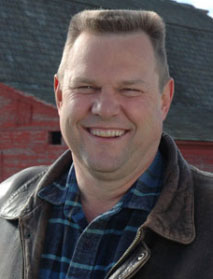
tester213

U.S. Sen. Jon Tester (D-MT)

Senators Jon Tester (D-Mont.), Mike Enzi (R-Wyo.), and Tim Johnson (D-S.D.) are leading a bipartisan coalition of Senators in calling on the U.S. Department of Agriculture and the U.S. Trade Representative to work with consumers, ranchers and meatpackers to make sure that American families know where their meat comes from.

The National Farmers Union is commending the group for fighting for consumers’ right to know and American farmers.

“We thank Senator Tester for his work in garnering support in the Senate in regards to COOL compliance,” said NFU President Roger Johnson. “Consumers have a right to know where their food comes from and U.S. farmers and ranchers want to be able to tell them.”

The World Trade Organization (WTO) recently required the USDA to adjust its rules requiring American retailers to clearly label where meat was raised and processed. The WTO said that while the United States can require meat labeling, current U.S. Country-of-Origin labeling (COOL) rules do not meet WTO standards. The WTO has given the United States until May 23, 2013, to bring its COOL rules into compliance.

“USDA and USTR should take even stronger regulatory actions to make sure that COOL provides meaningful information about the origins of meat and other products,” said Johnson.

“Congress intended that COOL provide as much information as possible about the origin of all meat cuts to consumers,” the senators wrote to U.S. Secretary of Agriculture Tom Vilsack and U.S. Trade Representative Ron Kirk. “Some flexibility is needed, but such flexibility cannot come at the expense of providing reliable information to families about the national origin of meat products.”

The bipartisan coalition also said that USDA should host a public comment period to allow agriculture workers and consumers to weigh in on any new proposals.


Filed Under: Blog Tagged With: COOL, Jon Tester, Mike Enzi, Tim Johnson, WTO

NFU Releases New “Farmer’s Share” Report

February 7, 2013 By Ron Sylvester Leave a Comment

farmershare213

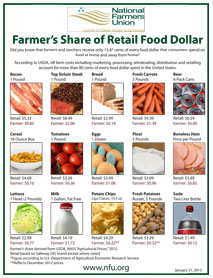
National Farmers Union released its latest Farmer’s Share earlier this week. The report is based on calculations derived from the monthly Agriculture Prices report produced by the U.S. Department of Agriculture’s (USDA) National Agricultural Statistics Service (NASS), and compared to price points of common grocery food items at a local Washington, D.C., Safeway supermarket.

“It’s easy to forget the true value of our farmers and ranchers, who in some cases are only making pennies to the dollar on their goods, while we’re at our local supermarket,” said NFU President Roger Johnson. “Our Farmer’s Share report reflects the true value that our farmers and ranchers are receiving.”

According to USDA’s Economic Research Service, farmers and ranchers only receive 15.8 cents of every food dollar spent by consumers outside the home in the United States. Additionally, more than 80 cents of every food dollar is spent on marketing, processing, wholesaling, distribution and retailing.

Among the more startling statistics noted in the January Farmer’s Share:

  • Dairy farmers received $1.72 for one gallon of fat free milk (retail price: $4.19);
  • Wheat farmers netted only 19 cents of the $2.99 retail price of a loaf of bread; and
  • Tomato growers received a mere 36 cents per pound (retail price: $3.28).

“The Farmer’s Share shows the consumer that prices may increase in the grocery store, however the farmer is not necessarily receiving extra income. This is critical information that every consumer should be aware of,” said Johnson. “It is also a stark reminder that U.S. family farmers and ranchers need certainty and Congress’ inability to pass the 2012 Farm Bill directly will impact their operations.”

Click here for a downloadable, printable Farmer’s Share page.


Filed Under: Blog Tagged With: Farmer's Share, National Farmers Union

« Previous Page
Next Page »
  • Email
  • Facebook
  • RSS
  • YouTube

Latest News from the Ohio & National Farmers Union

OFU Rallies for Rural Schools

Fair School Funding Plan Integral for Rural Public Schools COLUMBUS – The League of Women Voters of Ohio and Ohio Farmers Union held a Statehouse … Read More

Public Schools Build Connections in Rural Communities. Vouchers Tear Them Down.

by Melissa Cropper, president, Ohio Federation of Teachers This op-ed was orignally published on Barn Raiser: Rural communities depend on … Read More

National Farmers Union Week of Action for Strong Farm Bill

National Farmers Union (NFU) today concluded the Week of Action that gathered more than 100 farmers from across the country to the halls of Congress … Read More

How Do Tariffs Affect Family Farms?

A Talk in Kent, Ohio with Ohio Farmers Union and Others Have you noticed the price of eggs? Who hasn’t! How do government actions and tariffs … Read More

Check Out the Entire Blog

NATIONAL FARMERS UNION

Click to Take Action


Contact

Ohio Farmers Union
P.O. Box 363
1011 N. Defiance Street
Ottawa, Ohio 45875
Phone: (419) 523-5300
Toll Free: (800) 321-3671

Copyright Ohio Farmers Union© 2026 | Site by: RCS Communications


Loading Comments...