Ohio Farmers Union

Serving Family Farmers and Consumers Since 1934


United to Grow Family Agriculture Since 1934

  • About
    • The Farmers Union Triangle
    • Vision
    • OFU Leadership
  • Issues
    • 2020 Virtual Lobby Days
    • OFU Policy & NFU Policy
    • 2019 Lobby Day Registration
    • Get Involved!
    • NFU Climate Leaders
  • Education
    • 2019 OFU Essay Contest
    • Ohio Farmers Union Scholarships
    • Farm Safety
    • Renewable Energy Curriculum
  • Insurance
    • Hastings Mutual Insurance Co.
    • Health & Other Offerings
    • Ohio BWC Group Coverage
  • Join Us
    • Member Benefits
    • Insurance
  • Blog

Two Notes from USDA on Conservation Reserve Program

August 28, 2014 By Ron Sylvester Leave a Comment

fsalogo-featUSDA has issued two recent notices on the Conservation Reserve Program.

The first is just a reminder for farmers or landowners selling acres enrolled in CRP. Essentially, if CRP acres are sold, the original CRP contract must be revised and signed by the new owner within 60 days. If the contract is terminated by the new owner, the original CRP participant will be on the hook to refund USDA some payments:

If the new landowner elects not to continue the CRP contract, the contract will be terminated. When a contract is terminated, refund of the following payments plus interest is required from the original CRP participant: all annual rental payments, all cost share payments, signup incentive payments, and practice incentive payments.  Liquidated damages are also assessed.

Refunds of payments will not be required in cases where the owner’s estate or the heirs do not succeed to the contract.  There are other cases that do not require the refund of payments, when a participant loses control of the land, such as eminent domain.

The other notice was that under the new Farm Bill early termination of some CRP contracts will be allowed. Early outs are available for the following contract types:

  • CP1-establishment of permanent grasses
  • CP2-establishment of permanent grasses
  • CP3-tree planting
  • CP10-grass cover already established
  • CP11-tree cover already established

Here’s a link to a USDA fact sheet on early CRP contract terminations under the new Farm Bill

As always, you can receive more information by contacting your local USDA Farm Services Agency office.

Filed Under: Blog Tagged With: 2014 Farm Bill, Conservation Reserve Program, CRP, Farm Bill, USDA

USDA Update on 2014 Farm Bill Implementation

August 7, 2014 By Ron Sylvester Leave a Comment

Outlined below is a list, by Farm Bill title, of the components of the recently enacted Farm Bill and the U.S. Dept. of Agriculture’s progress in implementing the new law. This was released by USDA on August 6, 22014.


TITLE I – Commodity Programs

  • Agricultural Risk Coverage Program and Price Loss Coverage Program: On April 29, USDA began a competitive process to award funding for Farm Bill decision aids and outreach tools for the new Agricultural Risk Coverage Program and Price Loss Coverage Program. Awards totaling $6 million were announced in May 2014. On August 1, farmers and ranchers began receiving acreage history and yield updates to prepare them for later enrollment in these safety-net programs.
  • Supplemental Agricultural Disaster Assistance: On April 14, USDA published a final rule to implement the disaster assistance provisions. Sign up for these programs began on April 15, 2014.
    • As of July 31, 2014, approximately 238,000 applications have been received and $1.85 billion in payments have been disbursed through the Livestock Indemnity Program, Livestock Forage Disaster Program, and Tree Assistance Program.
    • On July 31, USDA extended the deadline for the Emergency Assistance for Livestock, Honeybees, and Farm-Raised Fish Program to August 15, 2014.
    • On July 22, USDA announced Noninsured Crop Disaster Assistance Program (NAP) assistance for losses to bush or tree fruit crops due to frost or freeze during the 2012 crop year.
  • Beginning Farmers and Ranchers: On June 23, USDA announced new support for beginning farmers and ranchers, including waiving fees for certain disaster assistance programs, eliminating payment reductions under the Conservation Reserve Program (CRP), and increasing payment rates by 50 percent under Emergency Assistance for Livestock, Honeybees and Farm-Raised Fish Program (ELAP).
  • Dairy Forward Pricing Program: On March 21, USDA re-established the Dairy Forward Pricing Program and on March 28, extended Milk Income Loss Contracts until September 1.
  • Loan Rates: On June 24, USDA announced loan rates for 2014 Crop Peanuts. County and regional loan rates were announced in a press release on March 28, 2014.
  • Extension of Programs: On March 28, the Farm Service Agency (FSA) published in the Federal Register notices for the extension of the following programs: (1) Marketing Assistance Loans; (2) Milk Income Loss Contract; (3) Dairy Indemnity Payment Program; (4) Non-Insured Crop Disaster Assistance Program; (5) Loan Deficiency Payments; and (6) Sugar.

[Read more…]

Filed Under: Blog Tagged With: 2014 Farm Bill, Farm Bill, USDA

CAUV Values to Skyrocket for 2014 Tax Year

August 7, 2014 By Ron Sylvester 5 Comments

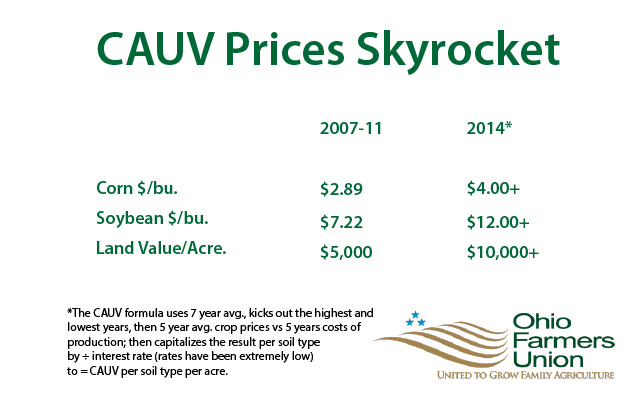
CAUV-2014-ChartFixedFarmers across Ohio have benefited in the past in regards to CAUV values that have been kept extremely low and now these values are scheduled to increase quite a bit in the next few years.

Ted Finnarn, Darke County attorney, is the Ohio Farmers Union representative to the Agricultural Advisory Committee of the Division of Tax Equalization and this CAUV Advisory Committee functions to advise the Ohio Department of Taxation on the operation of the Current Agricultural Use Valuation (CAUV) law and the consequent valuations used under the law.

Finnarn has served on this State Committee for over 38 years originally being appointed by the Ohio Farmers Union in 1976. Scott Zumbrink, Darke County Treasurer, has also served on the committee, representing the State Treasurers’ Association since 2007.

According to Finnarn and Zumbrink, the CAUV table valuations (which vary according to soil type, slope, drainage and soil management groups, using inputs of a 5-year “olympic” average of crop prices and costs of production) will increase substantially for tax year 2014 effective for taxes to be paid in 2015. When the more important comparison is made between the 2011 table valuations to the 2014 valuations (the 2011 table being the last one used by counties, which will now use the 2014 values, due to the 3 year rotation), farmers may see increases of approximately 110-185% or more in CAUV values.

[Read more…]

Filed Under: Blog Tagged With: CAUV, Chart, Ohio, Ohio Farmers Union, Scott Zumbrink, Ted Finnarn

Job Posting: NFU in Washington, D.C. Looking for Govt. Relations Representative

August 7, 2014 By Ron Sylvester Leave a Comment

If you know someone with a background in agriculture, politics and a keen interest in advocating on behalf of family farmers, ranchers and fishers around the country – and they would be interested in working for the National Farmers Union – have them take a look at the link below:

Job Posting: NFU Government Affairs Representative

Filed Under: Blog Tagged With: Jobs, Lobbyist, National Farmers Union

A few words on Toledo water crisis

August 6, 2014 By Ron Sylvester 2 Comments

Well, when roughly half a million people in and around Ohio’s fourth largest city can’t shower, wash clothes and dishes or drink their tap water for two days, the politicians start to pay attention to the annual environmental catastrophe known as the Lake Erie algal bloom.

If you’ve followed the Ohio Farmers Union’s take on water quality and agriculture’s role, you’ll know that OFU acknowledges the science that places agriculture at the top of the list of contributors of nutrients into Lake Erie and other surface waters and we are committed to having agriculture be a major part of the solution.

In reviewing the State’s response to our water quality problems, we believe there is one segment of nutrient management that has been ignored by the decision-makers in Columbus. That’s the use of manure from large animal feeding operations. Ohio is home to many thousands of these industrial scale livestock facilities. Only the 200 largest of which are managed under oversight of the Ohio Department of Agriculture (ODA). Manure from confined animal feeding operations supplies a significant proportion of the nutrients that Ohio farmers use to boost crop production.

[Read more…]

Filed Under: Blog Tagged With: Fertilizer, Lake Erie, Manure, Nutrient Management, SB 150, SB 490, Toledo, Water

FSA Update: Margin Protection Program for Dairy Producers

August 5, 2014 By Ron Sylvester Leave a Comment

The following is from USDA Farm Service Agency:

The 2014 Farm Bill authorizes a new dairy program, the Margin Protection Program for Dairy Producers (MPP-Dairy), which will replace the Milk Income Loss Contract (MILC) program no later than September 1, 2014.  The MPP-Dairy program is a voluntary program that provides dairy operations with risk management coverage that will compensate producers when the difference between the all-milk price and the average cost of feed falls below a certain level selected by the producers in a dairy operation.

Eligible producers can obtain either a catastrophic level of coverage for their dairy operation by paying a $100 administrative fee annually or they may obtain increased coverage at various levels by paying a premium in addition to the administrative fee.  Available price coverage levels begin at $4.00 and coverage may be increased in $.50 increments through $8.00 per hundredweight.  Available coverage percentages begin at 25 percent and coverage may be increased in 5 percent increments through 90 percent.  A dairy operation’s selection of a $4.00 coverage level with a coverage percentage of 90 is considered the catastrophic level of coverage.  Indemnity payments under the program will be triggered when margins fall below the producer-selected levels.

[Read more…]

Filed Under: Blog Tagged With: Dairy, FSA, Margin Protection Program, MPP-Dairy, USDA

Johnson Makes the Argument in Favor of COOL to Capitol Hill newspaper

August 5, 2014 By Ron Sylvester Leave a Comment

NFU President Roger Johnson is the author of a guest op-ed which ran in The Hill a Washington, D.C. newspaper and website which covers Congress. Click the link below to read Johnson’s argument in favor of COOL.

Consumers have a right to know where their food comes from

From the National Farmers Union News Release on the Piece:

“Nobody seemed to care where their pet treats came from until dogs started dropping dead from eating tainted food from China,” notes Johnson.   “When it was all over, the Food and Drug Administration (FDA) had received 5,600 complaints from consumers about their pets getting sick and, sadly, about 1,000 of them perished.”

Johnson points out that, thankfully, Congress understood that consumers have a right to know where their pet food, and their own food, comes from, and in 2008 passed a law known as COOL. “In short, COOL says that muscle cuts of meat, and some fruits and vegetables, must be labeled with the country’s name where it was produced.”

COOL doesn’t restrict imports; it simply gives grocery shoppers information to make purchasing decisions that are right for their families.  “If a family prefers Vietnamese catfish or Mexican meatloaf, there will be available options.  If not, the family can choose locally grown U.S. alternatives,” he notes.

A May 2013 public opinion poll showed more than 90 percent of consumers support COOL.  Johnson notes just last week “consumer advocates prevailed when the District Court of Appeals handed multinational meat packers a stinging defeat.  By a 9 to 2 majority, the panel upheld an earlier court ruling to deny a request to halt enforcement of the law.”

Foreign countries and their big business partners are also pushing international courts at the World Trade Organization (WTO) to intervene.  “The same WTO that helped facilitate lopsided trade deals and outsource U.S. manufacturing jobs will soon rule on what information U.S. grocery shoppers can receive,” he notes.

“Simultaneously, powerful lobbying groups are bankrolling efforts to ‘reform’ COOL in Congress, and by reform, they mean gut it.  Instead of ‘Born, Raised and Harvested in the U.S.,’ they’re pushing for ‘Made in North America’ labels so consumers can’t differentiate between products of Mexico, Canada or the United States.”

“What’s next?” he asks. “Made on Earth labels?”

“America has the safest, best homegrown food supply in the world.  Let’s be proud, not ashamed, of that accomplishment,” he concludes.

Filed Under: Blog Tagged With: COOL, Roger Johnson, The Hill

COOL Opponents Lose Again in Court

July 29, 2014 By Ron Sylvester Leave a Comment

from the National Farmers Union

WASHINGTON (July 29, 2014) – National Farmers Union (NFU) President Roger Johnson issued the following statement after receiving news of the District Court of Appeals’ en banc decision on a challenge to enforcement of Country-of-Origin Labeling (COOL) by the multinational meatpackers and our foreign competitors. By a 9-2 majority, the panel upheld an earlier 3-judge panel decision to deny an appeal to halt the enforcement of the popular labeling law, passed in 2008.

“NFU, and our broad coalition of consumer and producer organizations, have achieved yet another victory in our long battle to uphold the enforcement of the COOL regulation as modified by the U.S. Department of Agriculture’s (USDA). This marks the third time that COOL has won in court. There is no need for this case to proceed.

“The Court ruled that the government may require factual, uncontroversial information to be included on a label. American consumers want to know basic information about where their meat comes from, and livestock producers across this great nation are very proud of what they produce and happy to let consumers know where their meat comes from. USDA’s new COOL rules will significantly improve the information available to consumers by reducing confusion about the origins of meat products. It will also provide U.S. livestock producers the opportunity to differentiate their products, which they are proud to claim as theirs.”

WASHINGTON (July 29, 2014) – National Farmers Union (NFU) President Roger Johnson issued the following statement after receiving news of the District Court of Appeals’ en banc decision on a challenge to enforcement of Country-of-Origin Labeling (COOL) by the multinational meatpackers and our foreign competitors.  By a 9-2 majority, the panel upheld an earlier 3-judge panel decision to deny an appeal to halt the enforcement of the popular labeling law, passed in 2008.

 “NFU, and our broad coalition of consumer and producer organizations, have achieved yet another victory in our long battle to uphold the enforcement of the COOL regulation as modified by the U.S. Department of Agriculture’s (USDA).   This marks the third time that COOL has won in court. There is no need for this case to proceed. 

“The Court ruled that the government may require factual, uncontroversial information to be included on a label. American consumers want to know basic information about where their meat comes from, and livestock producers across this great nation are very proud of what they produce and happy to let consumers know where their meat comes from.  USDA’s new COOL rules will significantly improve the information available to consumers by reducing confusion about the origins of meat products.  It will also provide U.S. livestock producers the opportunity to differentiate their products, which they are proud to claim as theirs.”

– See more at: http://nfu.org/index.php?option=com_content&view=article&id=2575&catid=295#sthash.fEjpVZMc.pOdPJa89.dpuf

WASHINGTON (July 29, 2014) – National Farmers Union (NFU) President Roger Johnson issued the following statement after receiving news of the District Court of Appeals’ en banc decision on a challenge to enforcement of Country-of-Origin Labeling (COOL) by the multinational meatpackers and our foreign competitors.  By a 9-2 majority, the panel upheld an earlier 3-judge panel decision to deny an appeal to halt the enforcement of the popular labeling law, passed in 2008.

 “NFU, and our broad coalition of consumer and producer organizations, have achieved yet another victory in our long battle to uphold the enforcement of the COOL regulation as modified by the U.S. Department of Agriculture’s (USDA).   This marks the third time that COOL has won in court. There is no need for this case to proceed. 

“The Court ruled that the government may require factual, uncontroversial information to be included on a label. American consumers want to know basic information about where their meat comes from, and livestock producers across this great nation are very proud of what they produce and happy to let consumers know where their meat comes from.  USDA’s new COOL rules will significantly improve the information available to consumers by reducing confusion about the origins of meat products.  It will also provide U.S. livestock producers the opportunity to differentiate their products, which they are proud to claim as theirs.”

– See more at: http://nfu.org/index.php?option=com_content&view=article&id=2575&catid=295#sthash.fEjpVZMc.pOdPJa89.dpuf

Filed Under: Blog

Patience, Planning Key for Preparing for Latest Farm Bill

July 28, 2014 By Ron Sylvester Leave a Comment

More than 250 farmers and others interested in Ohio agriculture attended a recent 2014 Farm Bill Forum sponsored by the Ohio Farmers Union.

More than 250 farmers and others interested in Ohio agriculture attended a recent 2014 Farm Bill Forum sponsored by the Ohio Farmers Union.

Passed earlier this year, the latest five-year Farm Bill is not yet fully implemented, but farmers who run the gamut from direct marketing of specialty crops or livestock to commodity producers of corn and soybeans will notice changes in the federal safety net for family farms.

“Because this new law brings change – and a new set of issues for farmers to consider – the Ohio Farmers Union brought together some of the nation’s foremost experts on USDA programs to explain the new law,” said Joe Logan, president of the Ohio Farmers Union.

Speakers at the forum included USDA officials, academics and congressional staff who helped draft the new law.

The major takeaway from this year’s Farm Bill is the move away from direct payments and toward federally-backed crop insurance. In this new world even those farmers who are not producing major commodities like corn and soybeans in Ohio may benefit from new “whole farm” coverage according to Joe Schulz, chief economist for the U.S. Senate Committee on Agricutlture.

Undoubtedly, though, in Ohio there are thousands of farmers growing commodities who are wondering what the new ag safety net has in store for them.

President of the Ohio Farmers Union, Joe Logan, speaks at the recent forum. Members of the first panel, (L-R) include Jonathan McCracken, aide to U.S. Sen. Sherrod Brown; Joe Schulz, chief economist, U.S. Senate Ag Committee; and Carl Zulauf, professor at Ohio State University.

President of the Ohio Farmers Union, Joe Logan, speaks at the recent forum. Members of the first panel, (L-R) include Jonathan McCracken, aide to U.S. Sen. Sherrod Brown; Joe Schulz, chief economist, U.S. Senate Ag Committee; and Carl Zulauf, professor at Ohio State University.

Under the new law, farmers will take one of two paths regarding major commodities. One option is Price Loss Coverage, or PLC, a price-based assistance program. The other is Agricultural Risk Coverage, or ARC, a farm revenue-based program. The choice farmers make around the country will stick with them for the next five years.

“I do own farmland – I’ll be making many of these decisions that you are going to make,” said Carl Zulauf, a professor at Ohio State University’s Dept. of Agricultural, Environmental and Development Economics.

For agricultural commodity producers, Zulauf said there are three major decisions to make regarding participation in USDA-backed safety net programs in the 2014 Farm Bill. They are base yields, the option to reallocate base acres and a choice between a program that serves multiple year losses or shallow losses.

Zulauf went through several scenarios based on how farmers may make those decisions. Ultimately, decisions made regarding the 2014 Farm Bill may come down to whether a producer is attempting to cover losses or maximize federal crop insurance payments.

While the decision-making process is more complex this year – and producers’ decisions will last for the five-year length of the current Farm Bill – there is time and help available to farmers according to Terry Nicholson of USDA Farm Service Agency.

“Until the rules are written and published, there’s not much that Farm Service Agency can do with this program,” Nicholson said.

However, he said that officials understand that the changes are complex and there will be time available – probably over this winter – for farmers to work with their local FSA offices to sign up for programs. Those sign-ups will be retroactive for the 2014 crop year.

Terry Cosby, USDA State Conservationist in Ohio reminded farmers that all producers wishing to participate in USDA crop insurance programs will need to have on file with their local FSA office a Highly Erodible Land Conservation and Wetland Conservation Certification, also known as an AD-1026 form. Those forms and assistance in completing them may be obtained from local FSA representatives.


Filed Under: Blog

Thanks to Sponsors of OFU 2014 Farm Bill Forum

July 28, 2014 By Ron Sylvester Leave a Comment

We want to take a moment today and thank the sponsors of the Ohio Farmers Union 2014 Farm Bill Forum. First Federal Bank, POET biorefining and Superior Energy helped make our event at Bowling Green State University possible. More than 250 farmers and others interested in Ohio food and fiber benefited from the afternoon of presentations and answered questions. We here at Ohio Farmers Union sincerely thank our sponsors and encourage you to consider their products and services.

first-federal-logo-175

poet-175superior-175

Filed Under: Blog

« Previous Page
Next Page »
  • Email
  • Facebook
  • RSS
  • YouTube

Latest News from the Ohio & National Farmers Union

OFU Rallies for Rural Schools

Fair School Funding Plan Integral for Rural Public Schools COLUMBUS – The League of Women Voters of Ohio and Ohio Farmers Union held a Statehouse … Read More

Public Schools Build Connections in Rural Communities. Vouchers Tear Them Down.

by Melissa Cropper, president, Ohio Federation of Teachers This op-ed was orignally published on Barn Raiser: Rural communities depend on … Read More

National Farmers Union Week of Action for Strong Farm Bill

National Farmers Union (NFU) today concluded the Week of Action that gathered more than 100 farmers from across the country to the halls of Congress … Read More

How Do Tariffs Affect Family Farms?

A Talk in Kent, Ohio with Ohio Farmers Union and Others Have you noticed the price of eggs? Who hasn’t! How do government actions and tariffs … Read More

Check Out the Entire Blog

NATIONAL FARMERS UNION

Click to Take Action


Contact

Ohio Farmers Union
P.O. Box 363
1011 N. Defiance Street
Ottawa, Ohio 45875
Phone: (419) 523-5300
Toll Free: (800) 321-3671

Copyright Ohio Farmers Union© 2025 | Site by: RCS Communications


Loading Comments...