Ohio Farmers Union

Serving Family Farmers and Consumers Since 1934


United to Grow Family Agriculture Since 1934

  • About
    • The Farmers Union Triangle
    • Vision
    • OFU Leadership
  • Issues
    • 2020 Virtual Lobby Days
    • OFU Policy & NFU Policy
    • 2019 Lobby Day Registration
    • Get Involved!
    • NFU Climate Leaders
  • Education
    • 2019 OFU Essay Contest
    • Ohio Farmers Union Scholarships
    • Farm Safety
    • Renewable Energy Curriculum
  • Insurance
    • Hastings Mutual Insurance Co.
    • Health & Other Offerings
    • Ohio BWC Group Coverage
  • Join Us
    • Member Benefits
    • Insurance
  • Blog

All live bird exhibitions – including fairs – banned in Ohio this year

June 2, 2015 By Ron Sylvester Leave a Comment

Agency takes proactive stance in face of bird flu threat

from the Ohio Dept. of Agriculture

REYNOLDSBURG, Ohio (June 2, 2015) – In an aggressive move designed to help protect Ohio’s $2.3 billion poultry industry from the avian flu that has so negatively impacted other poultry-producing states, today the Ohio Department of Agriculture canceled all live bird exhibitions this year.  The ban includes county and independent fairs, the Ohio State Fair, and all other gatherings of birds for show or for sale, including auctions and swap meets.  Similar bans have been enacted in other poultry states.  So far, Ohio is virus-free and the move is intended to continue that status.

Highly Pathogenic Avian Influenza (HPAI)—also called the avian flu – is an extremely contagious virus that primarily affects domestic poultry and is believed to be spread by wild, migrating birds.  The United States Department of Agriculture’s (USDA) Animal and Plant Health Inspection Service (APHIS) first confirmed the virus in the U.S. beginning in late 2014.  Since that time more than 44 million birds at more than 197 locations have been affected.

“This was a difficult decision because it means young people can’t show their birds at fairs, but it’s in the best interest of an industry that literally thousands of Ohio families and businesses depend on and which provides billions of dollars to our state’s economy.  The right move isn’t always the easy move, but this is the right move, especially when you see just how devastating the virus has been to other big poultry states like Iowa and Minnesota.  Ohioans need to do all we can to ensure that we protect our industry and that we help avoid a costly spike in the price of important foods like chicken, turkey and eggs,” said Ohio Department of Agriculture Director David T. Daniels.

Ohio is the second largest egg producer in the country and home to 28 million laying chickens, 12 million broilers, 8.5 million pullets and 2 million turkeys.  Ohio’s egg, chicken and turkey farms employ more than 14,600 jobs and contribute $2.3 billion to the state’s economy.  Ohio’s role in national poultry production is even greater considering the loss that other major poultry states are experiencing.
[Read more…]

Filed Under: Blog Tagged With: Avian Flu, Ban, Bird Flu, County Fairs, David Daniels, Ohio

Ohio Dept. of Taxation Documents Regarding CAUV

June 1, 2015 By Ron Sylvester Leave a Comment

We know that CAUV valuations have been a hot-button issue for many family farmers in Ohio over the past few years. The latest information is here. In addition to that, here are three documents released by the Ohio Dept. of Taxation in May 2015:

  1. 2015 CAUV Table – Ohio Dept. of Taxation, May 2015
  2. Explanation of 2015 CAUV Values
  3. May 2015 PowerPoint Presentation from Ohio Dept. of Taxation on CAUV

Filed Under: Blog Tagged With: CAUV, Department of Taxation, Documents, Joe Testa, State of Ohio

OFU lauds initial tweaks to CAUV, but more is needed

June 1, 2015 By Ron Sylvester 1 Comment

Woodlands need more attention from state officials

Mel Borton, Ohio Farmers Union.

Mel Borton, Ohio Farmers Union.

In more than 80 years of life spent on and around Ohio’s farms, Mel Borton has seen cycles of woodlands preservation and cutting the woods on farmland.

“One sure way to remove woodlands across the state is for the real estate tax code to essentially promote chopping down trees,” said Borton.

“In my first 40 years, farmers cleared their woods as fast as they could. In my last 40 years farmers were conserving woodlands. It seems like the pendulum is swinging away from conservation and that’s a shame,” Borton added.

Mel Borton, left, talks to fellow OFU member Karen Wood at OFU's summer picnic in 2014. The Ohio Farmers Union is the second-largest general farm organization in Ohio.

Mel Borton, left, talks to fellow OFU member Karen Wood at OFU’s summer picnic in 2014. The Ohio Farmers Union is the second-largest general farm organization in Ohio.

He fears that’s exactly what Ohio’s Current Agricultural Use Valuation system for taxing farmland is doing. He and other members of the Ohio Farmers Union are pleased that the Kasich Administration began fixing CAUV this year, but many, like Borton, worry that woodland valuations are still not functioning in the way that CAUV framers intended.

Borton, a retired farmer and former lobbyist for OFU, spoke out at last Thursday’s Ohio Dept. of Taxation CAUV Advisory Committee hearing.

“I told the committee that I volunteer answering phones at our (OFU’s) state office and farmers are telling me that they are clearing their woods because of CAUV,” Borton said.

“The folks in Columbus have done some good things this year to get the wild swings in CAUV under control, but they haven’t done enough on woodlands,” Borton added.

Ted Finnarn, OFU’s resident CAUV legal expert and a member of the state’s CAUV advisory committee said that woodland values will be lower in the 2015 tax year as compared to 2014, but OFU and other ag groups need to keep the pressure on the tax department to continue reviewing woodland valuations and the capitalization-interest rate.

“I think the Tax Department is moving in the right direction, but much more needs to be done to come up with CAUV values that are more reasonable,” Finnarn said.

Finnarn, a Greenville attorney, has been on the advisory committee since its inception in the 1970s. The committee met last week to hear public comment and to release the 2015 valuations for CAUV.

Ohio Tax Commissioner Joe Testa said his department has heard and responded to concerns about CAUV.

“I am certainly aware that there are some farmers and farm land owners facing tax increases but believe the factors impacting land values are moving in a favorable direction for the agriculture industry in Ohio,” Testa said.

“The CAUV remains a very valuable program for Ohio’s farmers which results in
significant property tax reductions when compared to land not being used in agriculture,” he added.

Testa said the values released last week affect the 24 counties in this year’s triennial CAUV re-valuation rotation.  According to the department, the average CAUV per acre in 2015 in Ohio is $1,388, which is 17 percent less than the 2014 valuation of $1,668.

The department made changes, as suggested by the Ohio Farmers Union and Ohio Farm Bureau earlier this year.

On behalf of OFU, Finnarn worked closely with the Farm Bureau and others across the state for more than two years as CAUV values began to wildly fluctuate.  Among the recent changes, Finnarn points out the following differences between the 2015 tax year and previous years:

  • Modifications to the Capitalization-Interest Rate by going to a longer term fixed rate with an 80% loan-20% equity split versus the previous more restrictive 60% loan-40% equity calculation.  This will have the effect of lowering CAUV values from the originally proposed values.
  • Correction to woodland values by updating and increasing the costs of clearing from $500 to $1,000 and increasing sub-surface drainage to $770 and surface drainage to $380.  Woodland values will be lower for 2015 as compared to 2014.
  • Improving the accuracy of input data in regards to crop prices and cost data by bringing it more current in regards to crop production yields, crop price values and costs.  Inputs from the Ohio State University crop enterprise budget for 2015 were put into the formula so that this represents no lag time.  These costs have increased – lowering the CAUV values from the original proposal.

Finnarn said some values are still increasing from the 2012 values, but not as much as they would have without the changes. Values will not change for the 41 counties that underwent their reappraisals and reevaluations for tax year 2014 (increased taxes paid in 2015).  However, these counties will benefit from the changes in the future when they recycle for reevaluations in three years in tax year 2017.

Filed Under: Blog Tagged With: CAUV, Current Agricultural Use Value, Joe Testa, John Kasich, Mel Borton, Ohio, Taxes, Woodlands

U.S. EPA: Waters of the US Rule Creates No New Permitting and Preserves Previous Exemptions

May 28, 2015 By Ron Sylvester Leave a Comment

From the EPA:

In an historic step for the protection of clean water, the U.S. Environmental Protection Agency and the U.S. Army finalized the Clean Water Rule today to clearly protect from pollution and degredation the streams and wetlands that form the foundation of the nation’s water resources.

The rule ensures that waters protected under the Clean Water Act are more precisely defined and predictably determined, making permitting less costly, easier, and faster for businesses and industry. The rule is grounded in law and the latest science, and is shaped by public input. The rule does not create any new permitting requirements for agriculture and maintains all previous exemptions and exclusions.

From National Farmers Union:

NFU President Roger JohnsonReleased the following statement :

“NFU’s policy opposes any expansion of jurisdiction under the Clean Water Act (CWA), but EPA has made genuine efforts in reaching out to agriculture stakeholders in the rule-making process and the final rule clearly demonstrates that the agency took the concerns of family agriculture under serious consideration.  While the rule is not perfect from our perspective, the final rule is an improvement over the proposed rule.

“The final rule puts bright-line limits on jurisdiction over neighboring waters, offering farmers increased regulatory certainty and mitigating the risk of enforcement or litigation. The final rule also provides more clarity on which ditches fall under the Clean Water Act jurisdiction, removing a gray area that has caused farmers and ranchers an incredible amount of concern.”

EPA Fact Sheet Material:

Specifically, the Clean Water Rule:

  • Clearly defines and protects tributaries that impact the health of downstream waters. The Clean Water Act protects navigable waterways and their tributaries. The rule says that a tributary must show physical features of flowing water – a bed, bank, and ordinary high water mark – to warrant protection. The rule provides protection for headwaters that have these features and science shows can have a significant connection to downstream waters.
  • Provides certainty in how far safeguards extend to nearby waters. The rule protects waters that are next to rivers and lakes and their tributaries because science shows that they impact downstream waters. The rule sets boundaries on covering nearby waters for the first time that are physical and measurable.
  • Protects the nation’s regional water treasures. Science shows that specific water features can function like a system and impact the health of downstream waters. The rule protects prairie potholes, Carolina and Delmarva bays, pocosins, western vernal pools in California, and Texas coastal prairie wetlands when they impact downstream waters.
  • Focuses on streams, not ditches. The rule limits protection to ditches that are constructed out of streams or function like streams and can carry pollution downstream. So ditches that are not constructed in streams and that flow only when it rains are not covered.
  • Maintains the status of waters within Municipal Separate Storm Sewer Systems. The rule does not change how those waters are treated and encourages the use of green infrastructure.
  • Reduces the use of case-specific analysis of waters. Previously, almost any water could be put through a lengthy case-specific analysis, even if it would not be subject to the Clean Water Act. The rule significantly limits the use of case-specific analysis by creating clarity and certainty on protected waters and limiting the number of similarly situated water features.

Filed Under: Blog Tagged With: U.S. EPA, Waters of the U.S., WOTUS

Logan: Why We Fight for Country of Origin Labeling

May 27, 2015 By Ron Sylvester Leave a Comment

by Joe Logan, President OFU

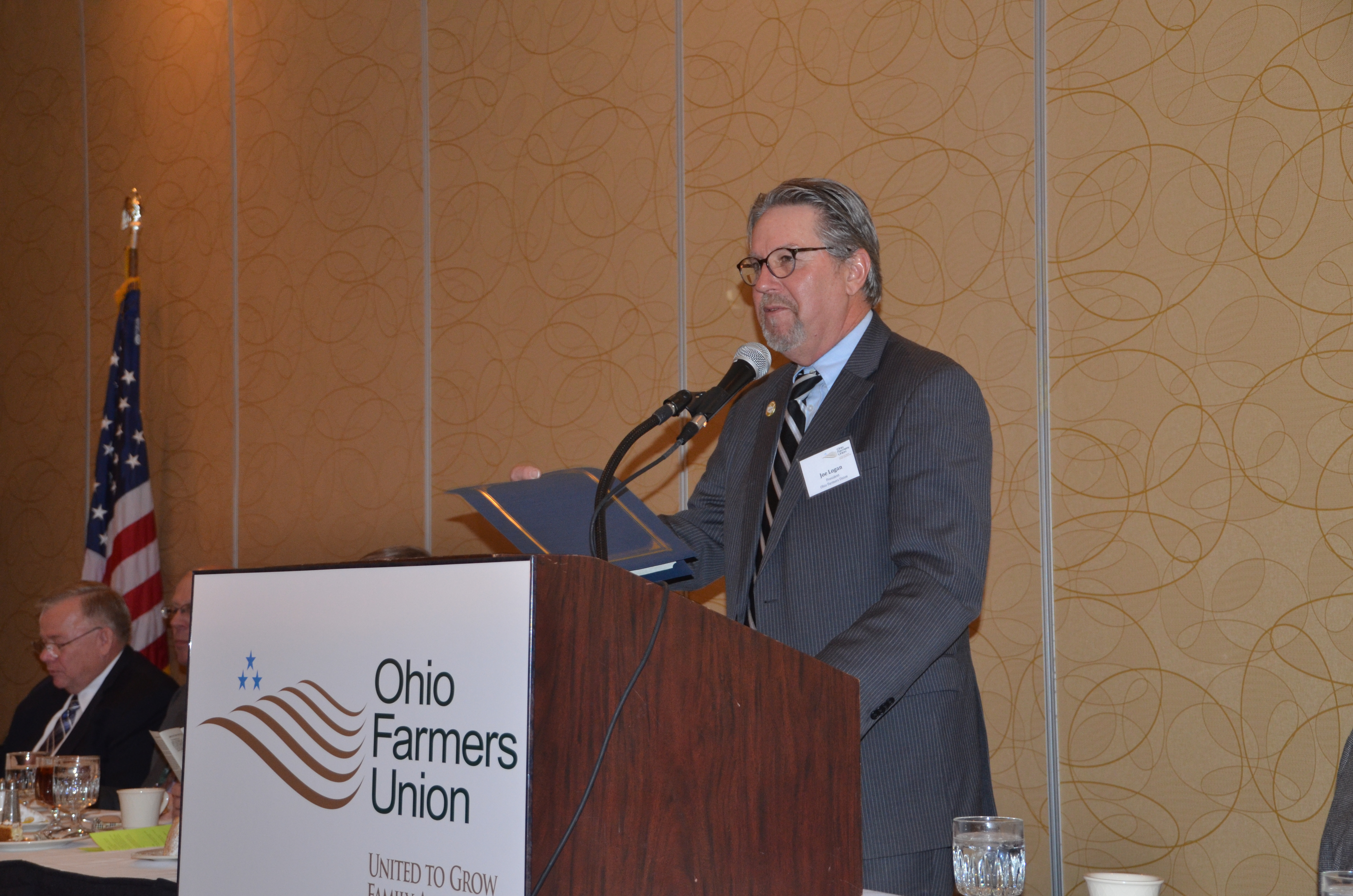
Joe Logan, OFU

OFU President Joe Logan addressing the organization in January 2015.

Sometimes it seems like a colossal waste of time and energy but organizations like ours are compelled to rise and speak out when destructive things are happening. Such was the case last week as an extraordinary series of events took place in Washington D.C.

On May 18, a dispute resolution panel from the World Trade Organization (WTO) announced its decision that an existing U.S. law requiring food companies to apply Country Of Origin Labeling (COOL) to many meat products presents a hardship to other nations who wish to sell their products to American customers. The dispute was initiated by Canada and Mexico, who together export about 7% of the beef and 5% of the pork consumed by Americans. Oddly, the dispute panel was chaired by a representative of Mexico.

As a result of their decision, Canada and Mexico will be given the chance to prove/document the economic harm they have suffered. Pending sufficient proof, they will be entitled to impose an equal value of penalties onto the offending country (the U.S.) in the form of tariffs of any American products of their choosing.

The WTO settles many such disputes each year and the process is often a multi-year affair, which includes numerous delays and much negotiation among the parties before a final resolution. This case, however, is taking a radically different course. The nations claiming to be harmed (Mexico and Canada) are supported by some organizations who are authorized by the U.S. government. As ridiculous as it might seem, the National Cattlemen’s Beef Association (NCBA) and the National Pork Producers Council (NPPC) – two organizations authorized by the U.S. Congress — are siding with our trading partners and against the United States in this case.

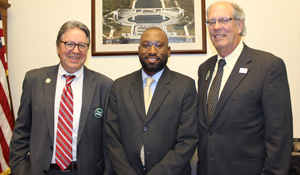
L-R: Joe Logan, Edward Edney, office of U.S. Rep. Marcy Kaptur, Roger Wise, OFU Treasurer. Logan and Wise were in Washington lobbying Congress on COOL in late May 2015.

L-R: Joe Logan, Edward Edney, office of U.S. Rep. Marcy Kaptur, Roger Wise, OFU Treasurer. Logan and Wise were in Washington lobbying Congress on COOL in late May 2015.

The rationale for this strange occurrence is simple but frightening in its implications. Our livestock producing, processing and marketing systems have been changing in profound ways. Our pork, poultry and beef industries have become highly integrated and globalized. They are now dominated by a handful of very large, global corporations. Gone are the days when independent farmers raised hogs and chickens and offered them for sale in local or regional markets. Although many independent cattlemen still raise calves, the feedlots where most cattle reach market weight are dominated by large corporate beef processors.

In such a global, integrated system, both processors and importers have taken seats on the boards of the organizations (like NCBA and NPPC) that were once held by independent farmers and ranchers. Now, those organizations serve the interests of their global corporate giants who own and control the lion’s share of the livestock, processing plants and distribution chains. If today’s globalized, integrated system had been this firmly in place in 2002, we would never have been able to get COOL enacted, despite that it is very strongly supported by both consumers and independent farmers.

The National Farmers Union fought vigorously for the better part of two decades to get COOL passed by Congress and enacted by USDA. We have been extremely proud to have championed a policy that was so robustly supported by consumers and that gave those remaining independent farmers and ranchers a chance to redeem the benefits of their extraordinary efforts to produce safe, high quality food products for American Consumers.

The changing structure of the livestock and food industry, along with the changing character of our more partisan congress, have created a seismic shift in the political landscape for issues like COOL. Members of Congress can now ignore the enormous popularity of issues like COOL (90% approval) and instead bow to the interests of corporate lobbyists who can provide resources needed to overwhelm any political foe.

In this political environment, it is not surprising that the opponents of COOL – the global food processing companies have mustered the resources to influence key members of congress to take extraordinary actions like the one that occurred on May 19: The House Ag Committee Chairman introduced a bill to repeal the COOL. Not only did Chairman Conaway introduce the bill, but he conducted an expedited “mark up” and committee vote to approve his bill the following day.

Despite our feverish efforts to inform many thoughtful members, the bill easily passed out of committee and will be scheduled for a vote on the floor of the House in June. After several days of work talking to hundreds of members of the House and Senate, we believe we have headed the stampede. We feel confident that the WTO process will have a chance to play out before Congress takes repeals the law.
We are also confident that Canada, Mexico and the global meat processors will be hard pressed to demonstrate any legitimate harm from our COOL law. If so, our hard-fought and highly popular policy may survive and serve the interests of consumers and for years to come.

If you haven’t already, please call your member of Congress and ask your friends and family – farmer and consumer alike – to do the same. Tell your representative that Americans deserve to know where their food comes and that America’s – and Ohio’s – family farmers deserve their right to proudly proclaim their bounty is a product of the U.S.A.

Filed Under: Blog Tagged With: Canada, Conaway, Congress, COOL, Joe Logan, Mexico, National Farmers Union, Ohio Farmers Union

Chickens: Last Week Tonight with John Oliver

May 19, 2015 By Ron Sylvester Leave a Comment

Filed Under: Blog Tagged With: Big Ag, Chickens, Factory Farms, John Oliver

Logan, Wise Lobby in D.C. to Preserve COOL

May 19, 2015 By Ron Sylvester Leave a Comment

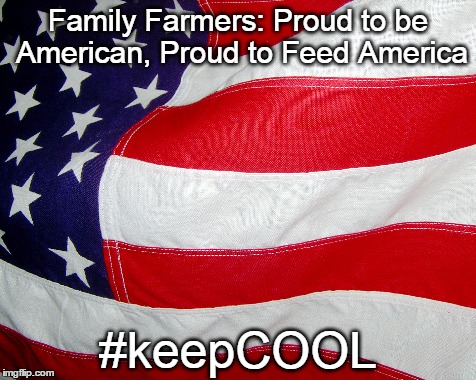
USAJoe Logan and Roger Wise are no strangers to the ongoing struggle in Washington, D.C. and Geneva, Switzerland over whether U.S. consumers have a right to know where their food comes from.

The pair are Ohio farmers but they are also the current president of the Ohio Farmers Union (Logan) and the immediate past-president (Wise). Since 2009, Country of Origin Labeling – “COOL” in agricultural circles – has been a recurring policy consideration for each.

COOL is a rule in the 2002 U.S. Farm Bill that mandates retailers provide country of origin labeling for beef, pork and lamb. In 2008, Congress expanded the labeling law to include some other products such as fresh fruits and nuts.

In 2009, the first challenge to COOL came from the Canadian government via the World Trade Organization. While Canada – and subsequently Mexico – have claimed that U.S. COOL rules have cost foreign producers, there is scant economic evidence to support their claims.

There has been, however, a sea change in ownership of U.S. meat interests. The primary owner of U.S. pork interests is now Shuanghui of China. JBS of Brazil is now the largest meat processing company in the United States. Both China and Brazil have issues regarding food safety.

“Yesterday’s WTO decision is an insult to all who wish to have information about the food they consume and an affront to our nation’s ability to adopt legislation that is strongly supported by US Farmers and consumers,” said Logan

“Once again, the Farmers Union will be leading the charge to defend COOL on behalf of farmers and consumers,” Logan said.

National Farmers Union President Roger Johnson is asking lawmakers to allow U.S. trade representatives to work things out with Mexico and Canada.

Johnson pointed out that there have been various press reports in recent weeks indicating that the administration will work with Canada and Mexico on COOL.

“We support that approach to the extent it results in a mutually agreed result that provides consumers meaningful information on the meat products they purchase, including the country where the animal was born, raised and slaughtered. With the significant interest by consumers in knowing where their food comes from, any other result is not acceptable,” Johnson said.

Logan, of Trumbull County, and Wise, of Sandusky County, have a full slate of meetings on Capitol Hill with members of Congress over the next two days. They are part of an NFU group of more than 60 Farmers Union leaders from around the country.

“Our primary message to Congress at this point is leave COOL alone,” said Wise.

“There is precedent for U.S. and international officials to work out their differences rather than scrap a U.S. law and start completely over,” he added.

Filed Under: Blog Tagged With: Congress, COOL, Country of Origin Labeling, Joe Logan, Roger Wise

NFU Urges Support for Livestock Mandatory Price Reporting

May 6, 2015 By Ron Sylvester Leave a Comment

nfunr2National Farmers Union (NFU) President Roger Johnson today encouraged Congress to reauthorize the Livestock Mandatory Price Reporting Act — an important tool in combatting problems caused by high concentration and vertical integration in livestock markets — and offered suggestions for making the price reporting data a more effective and usable tool for family farmers and ranchers.


“Price reporting is an important tool in addressing the market failures caused by the high levels of concentration in livestock markets,” said Johnson in a letter to Chairman Pat Roberts, R-Kansas, and Ranking Member Debbie Stabenow, D-Michigan, of the U.S. Senate Committee on Agriculture, Nutrition and Forestry. “NFU encourages the Senate to review and reauthorize the Livestock Mandatory Price Reporting Act in an open and transparent process.”

Johnson offered a series of suggestions for improving cattle reporting in order to capture more transactions and ensure the data is more accurate and usable. Those suggestions include:

  • Data omitted from public reports due to the confidentiality rule (3/70/20 confidentiality guideline) should be aggregated both weekly and regionally.
  • Clarify reporting definitions for cattle such that it is consistent with country-of-origin-labeling. Mandatory Price Reporting (MPR) data considers cattle to be of domestic origin even if they are imported, so long as they spend some time in U.S. feedlots. A recent report by Dr. Bob Taylor of Auburn University found this loophole resulted in roughly one million cattle per year failing to show up in MPR data, while showing up in trade statistics.
  • Require weekly reporting of market concentration through the use of the Herfindahl-Hirschman Index (HHI) for both captive supplies and cash transactions. This should be reported both regionally and nationally.
  • Improve usability of the MPR Dashboard and Data Mart, including prominent display of definitions for reports, weekly histograms with the day of the week for negotiated sales, and graphs showing the thinness of the cash market by day.
  • Separate the data for forward contracts from those tied to the futures market.

Johnson noted that the latest estimate for the four-firm concentration ratio (CR4) in beef indicates that the top four meatpackers control 85 percent of the market share – a serious competition issue reflected across the U.S. livestock industries.

[Read more…]

Filed Under: Blog Tagged With: Congress, Livestock Mandatory Price Reporting

Johnson Makes Case for COOL

May 5, 2015 By Ron Sylvester Leave a Comment

nfunr2National Farmers Union President Roger Johnson argued recently in Agri-Pulse that regardless of the upcoming announcement from the World Trade Organization (WTO) on America’s popular labeling law – Country-of-Origin Labeling (COOL) – Congress needs to let the WTO process run its course.

“The announcement from the WTO on this lawsuit is due in just weeks, and we may win.  If not, it can still be brought to arbitration. And that’s why it’s important that Congress refrain from making any changes to the popular labeling law until this process has run its course,” notes Johnson in Agri-Pulse. “To do otherwise would not only be unprecedented in U.S. history, but would also be a disservice to consumers who support COOL by a margin of 90 percent, according to decade’s worth of polling.”

Johnson notes that the food labeling movement is no longer confined to the U.S., but now includes the European Union as well. “A few years ago European politicians got an earful when their constituents learned that they were walking around with a stomachful ¾ of horsemeat. Meat from horses labeled as beef was being imported into the European Union (EU), and since strict labeling laws were not in place in one of the world’s most lucrative markets, consumers were tricked into eating something very different than they thought,” he notes.

Johnson notes the next step in the arbitration process, should the WTO rule against America’s consumers and producers in May, is that Canada and Mexico can retaliate against U.S. But the level of retaliation can be subject to arbitration, if requested by the U.S.  The level of arbitration is limited to the adverse effects on Canadian and Mexican exports to the U.S.

“Proving COOL has caused economic harm is going to be no small feat for Canada, given the recent study out of Auburn University that found it was the economic collapse of 2008 – not COOL – that caused a dip in Canadian exports to the U.S.,” he notes.

[Read more…]

Filed Under: Blog Tagged With: Agri-Pulse, Congress, COOL, Country of Origin Labeling, Roger Johnson, WTO

NFU: Clean Re-authorization of Grain Standards Act Needed from U.S. Senate

May 5, 2015 By Ron Sylvester Leave a Comment

nfunr2National Farmers Union President Roger Johnson this week urged the Senate to pass a clean reauthorization of the U.S. Grain Standards Act, calling the current system “the world’s gold standard.”

“Today’s framework, overseen by the Federal Grain Inspection Service (FGIS), is the world’s gold standard and our export partners have faith in that standard,” said Johnson in a letter to Chairman Pat Roberts, R-Kansas, and Ranking Member Debbie Stabenow, D-Michigan, of the U.S. Senate Committee on Agriculture, Nutrition and Forestry. “For a penny a bushel we have a cost-effective system that ensures consistency, reliability and accuracy. Our members have faith in the current system and as such request a clean reauthorization of the Grain Standards Act for a period of no less than 10 years.”

Johnson highlighted the continued drive towards privatization of the U.S. grain inspection system, a move that would weaken the strong reputation of U.S. exporters.

“The most concerning issue for our members is the continued drive towards the privatization of our grain inspection system,” said Johnson. “This nation’s trading partners trust the existing system, and changes to this system that result in inspections being conducted by entities other than the federal government or a delegated state agency would diminish the trust that has taken decades to build.” [Read more…]

Filed Under: Blog Tagged With: Grain Standards Act

« Previous Page
Next Page »
  • Email
  • Facebook
  • RSS
  • YouTube

Latest News from the Ohio & National Farmers Union

OFU Rallies for Rural Schools

Fair School Funding Plan Integral for Rural Public Schools COLUMBUS – The League of Women Voters of Ohio and Ohio Farmers Union held a Statehouse … Read More

Public Schools Build Connections in Rural Communities. Vouchers Tear Them Down.

by Melissa Cropper, president, Ohio Federation of Teachers This op-ed was orignally published on Barn Raiser: Rural communities depend on … Read More

National Farmers Union Week of Action for Strong Farm Bill

National Farmers Union (NFU) today concluded the Week of Action that gathered more than 100 farmers from across the country to the halls of Congress … Read More

How Do Tariffs Affect Family Farms?

A Talk in Kent, Ohio with Ohio Farmers Union and Others Have you noticed the price of eggs? Who hasn’t! How do government actions and tariffs … Read More

Check Out the Entire Blog

NATIONAL FARMERS UNION

Click to Take Action


Contact

Ohio Farmers Union
P.O. Box 363
1011 N. Defiance Street
Ottawa, Ohio 45875
Phone: (419) 523-5300
Toll Free: (800) 321-3671

Copyright Ohio Farmers Union© 2025 | Site by: RCS Communications


Loading Comments...